


Strategic Planning

Strategy dictates how a company creates value and competes; planning outlines the necessary steps to execute that vision. Combined, strategic planning defines how an organization intends to achieve a competitive advantage and the specific actions it will take to get there
For financial professionals, especially those in FP&A, strategic planning is a critical process that connects financial insight to business strategy and guides decisions on growth, investment and risk. In an increasingly complex business environment, it helps organizations stay focused, adaptable and aligned, ensuring day-to-day decisions support long-term success.
Quick Navigation
- What is strategic planning?
- What is a strategic plan?
- Benefits of strategic planning
- Strategic planning framework
- FP&A's role in strategic planning
- Strategic planning resources for finance professionals
- Strategic planning FAQs
AFP FP&A Guide to Navigating Business Turbulence
In an era defined by unpredictability, organizations face economic shocks, supply chain volatility, rapid market shifts and increasing operational risk. Learn best practices for finance leaders to respond decisively, communicate clearly and build lasting resilience.
What is strategic planning?
Strategic planning is the structured process organizations use to define priorities, allocate resources and align operations with long-term objectives such as revenue growth, profitability, market expansion or risk mitigation. At its core, it defines how the organization will compete — how it positions itself, deploys resources and directs activities to create and sustain its competitive advantage.
It also turns vision into action, providing a roadmap that connects high-level goals to execution across the business. The budget acts as the essential bridge in this process; as the first step in the strategic plan, the current year’s budget ensures that immediate activities remain aligned with the long-term vision. This is a core component of integrated business planning, where strategy, operational planning and reforecasting converge into a single, unified process.
It’s important to note that strategic planning is not a one-time exercise. Instead, it is an ongoing process that evolves as market conditions, competitive dynamics and internal capabilities change.
What is a strategic plan?
A strategic plan outlines the initiatives, investments and actions required to achieve the organization's goals over a defined period. While a common timeframe is three to five years, the length of time often depends on a company's asset lifecycle and its ability to respond to market shifts. For instance, asset-heavy industries like oil or automotive manufacturing require longer planning horizons, whereas software or retail sectors may use shorter planning periods.
A well-developed strategic plan includes:
- A definition of how the organization achieves competitive advantage.
- Clear strategic objectives aligned with organizational priorities, mission and vision.
- Key initiatives and programs required to achieve those objectives.
- Financial targets and performance metrics.
- Resource requirements and allocation decisions,
- Timelines and accountability across business units.
Because organizations operate in dynamic environments, strategic plans need to be regularly reviewed and updated to ensure they remain responsive to emerging risks and opportunities. Significant, long-horizon shifts, such as the arrival of new market entrants, competitor consolidation, new technology and leadership changes, can require adjustments to the strategic plan.
Benefits of strategic planning
Effective strategic planning creates value by improving clarity, alignment and execution across the organization. Key benefits include:
- Better decision-making: A clearly defined strategic plan focuses the range of viable options and provides a framework for evaluating decisions. Leaders can assess opportunities based on how well they align with strategic objectives, reducing uncertainty and improving speed.
- Improved alignment and coordination: Strategic planning ensures that all parts of the organization are working toward the same goals. It connects leadership priorities with execution at the business unit and operational levels, reducing silos and improving collaboration.
- Stronger organizational focus: By defining priorities, strategic planning helps organizations identify high-value investment choices and avoid pursuing initiatives that do not support long-term goals. This disciplined focus ensures that resources are not spread too thin across non-essential tasks.
- Enhanced governance and accountability: Strategic planning establishes clear expectations for performance. Combined with governance frameworks, it helps ensure decisions and actions remain aligned with expectations, improving transparency and accountability across the organization.
- Improved communication: Strategic planning provides a consistent narrative about where the organization is headed and why. This clarity helps engage employees, align stakeholders and build confidence among investors and partners.
Strategic planning framework
The strategic planning framework is an iterative process that outlines how strategies are developed, implemented and evaluated. At the center of an organization's strategy are mission, vision and values.
- Mission refers to the organization’s core purpose: what it does, who it serves and why it exists.
- Vision refers to the long-term impact the organization hopes to achieve.
- Values refer to the guiding principles and ethical standards that dictate how the organization operates and makes decisions.
While organizations may adapt the specifics, most strategic planning frameworks follow a similar set of steps:
1. Assess internal and external factors
Begin by analyzing factors that influence the organization’s ability to compete and create value.
- Internal factors include capabilities, resources and organizational culture — often things within management control.
- External factors include industry dynamics, competition and macroeconomic conditions — things beyond management control.
Tools such as SWOT analysis are commonly used to identify strengths, weaknesses, opportunities and threats, providing a foundation for strategic decision-making.
2. Set strategic goals
Based on the results of the assessment, organizations define clear, measurable goals describing what success looks like at the end of the planning period. Common strategic goals include:
- Market share
- Customer retention
- Customer growth
- Operational resilience
Strategic goals also serve as a mechanism for measuring progress and aligning stakeholders.
3. Develop strategies
Organizations then determine how they will achieve their goals. They choose a strategic position, making a fundamental choice: Will they compete on cost leadership (low margins, high volume) or differentiation (high margins, low volume)?
Once they’ve chosen a path, they identify specific approaches — such as expanding into new markets, improving operational efficiency or investing in innovation — to reinforce their chosen position.
Strategies are often structured across multiple time horizons:
- Short-term (core operations) — optimizing current performance
- Medium-term (growth initiatives) — expanding existing capabilities
- Long-term (innovation) — exploring new opportunities with higher uncertainty
A shared strategy and vision allow for different parts of the company to align resources and efforts.
4. Develop plans
Strategies are then translated into detailed plans that define how they’ll be executed. This includes operating plans, budgets and forecasts developed by business units and functional teams. Each layer of planning adds specificity, ensuring the organization has a clear path to achieving its strategic goals.
5. Allocate resources
Organizations must then allocate financial and operational resources to support their strategic initiatives. This often involves trade-offs, such as investing in high-growth opportunities while scaling back lower-performing areas. Analytical tools and frameworks can help prioritize investments and balance risk and return.
6. Measure performance
The final step involves evaluating how effectively the strategy is being executed. Organizations use performance metrics and frameworks, such as the balanced scorecard, to assess both financial and operational outcomes.
Performance measurement enables organizations to track progress toward goals, identify areas for improvement and adjust strategies as needed. As new information becomes available, organizations should refine their strategies and restart the process.
FP&A's role in strategic planning
FP&A plays a central role in connecting strategy to execution. Depending on the organization, FP&A may lead the strategic planning process or serve as a key partner to leadership.
Core responsibilities include:
- Providing business intelligence: Gathering and analyzing data on the organization, competitors and market environment.
- Supporting strategy development: Identifying value drivers, KPIs and the financial implications of strategic choices.
- Leading planning processes: Building financial models, forecasts and scenario analyses to guide decision-making.
- Developing projections: Estimating the financial outcomes of strategic initiatives based on operational and market assumptions.
- Enabling agility through scenario planning: Anticipating possible outcomes and preparing responses for a range of circumstances.
- Monitoring and refining strategy: Evaluating performance, updating forecasts and helping leadership adjust course as needed.
- Holding management accountable for delivering on strategic goals. Because management is entrusted with capital and resources, finance, as the steward of capital, must ensure the assets are used wisely and in alignment with the strategic plan.
In short, FP&A connects the long-term strategy to the budget process, ensuring that the organization’s strategy is measurable, actionable and financially viable.
Scenario Planning Framework
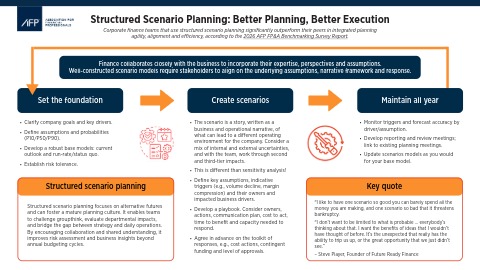
Structured scenario planning enables teams to challenge groupthink, evaluate departmental impacts, and bridge the gap between strategy and daily operations.
Strategic planning resources for finance professionals
Read a strategic planning case study that demonstrates how a collective approach improves the quality of the plan, flexibility when challenges arise and transparency across teams.
Validate your strategic planning expertise with the Certified Corporate FP&A Professional (FPAC) certification.
Get leading strategic planning practices from actual finance practitioners at the AFP FP&A Forum and the annual AFP Conference.
Strategic planning FAQs
How long does a strategic plan typically last?
Most strategic plans last three to five years; however, the timeframe can be longer or shorter, depending on the organization's industry, asset lifecycle and ability to respond to market shifts.
What is the difference between strategy and strategic planning?
Strategy defines how an organization will compete and create value. Strategic planning is the process used to develop and implement that strategy.
What tools are used in strategic planning?
Common tools include SWOT analysis, scenario planning, financial modeling and performance frameworks like the balanced scorecard.
Why is strategic planning important for financial professionals?
It allows finance teams to influence business direction, align financial resources with priorities and provide insights that improve decision-making.
How often should a strategic plan be updated?
Plans should be reviewed regularly — often annually — and updated as needed to reflect changes in performance, market conditions or strategic priorities.

🔍 Browse 140+ sessions by day or track
💡 Discover the speakers sharing
real-world treasury and finance strategies
🤝 Find networking experiences designed
to help you connect with peers
📅 Build your plan before you arrive
Start Exploring