


Risk and Opportunity

Good forecasting is good risk management. Effective risk management starts with understanding how uncertainty affects financial performance. When organizations take a structured approach to quantifying risks and opportunities, they improve scenario planning and make smarter strategic and operational decisions that are aligned with financial reality.
Ninety percent of finance professionals use lists of risks and opportunities to assess uncertainty, and more than half of those who use this approach consider it effective, according to the 2026 AFP FP&A Benchmarking Survey.
Quick Navigation
- What Is Risk and Opportunity Management
- Benefits of Risk and Opportunity Management
- Enterprise Risk Management vs. Risk and Opportunity Management
- FP&A's Role in Risk and Opportunity Management
Risk and Opportunity Template
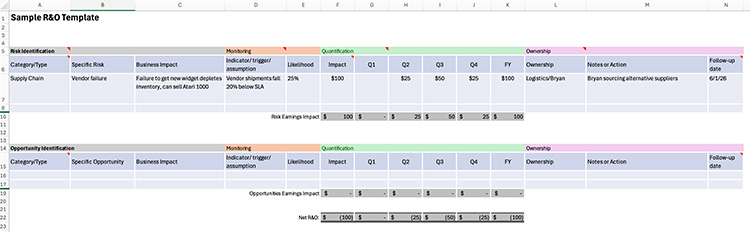
Fill out the form below to download a complimentary R&O template to help you manage risks and identify opportunities.
What Is Risk and Opportunity Management
Risk and opportunity (R&O) management is the structured process of identifying, assessing, responding to and monitoring uncertainties that could affect an organization's financial performance. This can be a negative impact (risk) or a positive impact (opportunity).
An effective R&O management process is part of a continuous performance management cycle:
- Identify internal and external factors that could impact financial results. Internal factors are those within an organization’s control or influence. Examples include production capacity and efficiency, inventory management, pricing models, product/service mix and technology infrastructure. External factors are those outside of an organization’s control. Examples include inflation and interest rates, customer demand, new competitors, regulatory changes and geopolitical tensions.
- Identify and monitor indicators to ensure (operational or finance) teams know what they are watching and when it is time to act and move into the baseline forecast (triggers).
- Assess the likelihood and potential financial impact of uncertainties. Both qualitative and quantitative risk assessments are useful for determining materiality, which helps finance teams prioritize risks and opportunities.
- Identify owners and plan responses to risks and opportunities in accordance with the organization’s risk appetite and strategic objectives. Responses to risk include avoiding the activity, implementing processes to mitigate the risk and transferring the risk (e.g., through insurance or hedging). Responses to opportunities include making new investments, reallocating resources and scaling up projects.
While the R&O management process can begin at any time, many finance professionals in the AFP community begin identifying external macro risks and doing internal self-examinations during the planning cycle, often through structured meetings or workshops.
After the budget development period, R&O management moves into a regular cadence, often tied to weekly flash reports, monthly reforecasts, quarterly business reports or board meetings. The frequency of updates and the method of communication vary based on a company’s meeting schedule and the speed of the risk/opportunity.
Benefits of Risk and Opportunity Management
R&O management is important because it helps organizations proactively develop responses to uncertainty. Without a structured approach, companies may miss emerging threats or make decisions based on incomplete information.
Benefits of R&O management include:
- Improved financial resilience: R&O management helps protect liquidity, enabling organizations to withstand economic and operational shocks.
- Enhanced agility: Continuously monitoring for early indicators enables organizations to respond quickly to changing conditions and adapt before issues escalate.
- Greater value creation: Looking for opportunities — not just threats — helps organizations identify areas for revenue growth, cost optimization and competitive advantage that might otherwise be overlooked.
- Stronger governance: Following a formal process improves documentation, accountability and communication with stakeholders.
Enterprise Risk Management (ERM) vs. Risk and Opportunity (R&O) Management
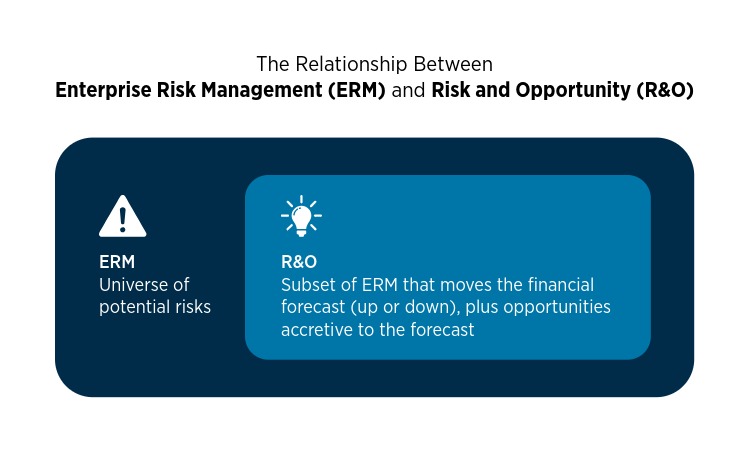
Enterprise risk management (ERM) is a strategic framework that enables organizations to systematically identify, assess and manage risks. It addresses all potential risks that could threaten an organization's objectives.
Risk and opportunity management is a subset of ERM that addresses uncertainties that could improve or worsen the expected range of financial outcomes within the planning horizon.
Factors that belong in an R&O report include:
- Revenue and top line: Changes in volume, pricing or customer demand
- Cost drivers: COGS, raw material volatility, freight and energy costs
- Operating expenses (OpEx): Marketing spend, IT costs and discretionary projects
- Headcount and talent: Hiring delays, attrition and wage inflation
- CapEx and investments: Timing of major projects and potential overruns
- Cash flow and working capital: Collections timing, inventory swings and supplier terms
- Supply chain and procurement: Disruptions, vendor risk and logistics bottlenecks
- Legal and compliance: Regulatory changes and litigation exposure
- IT and systems: Cybersecurity risks and ERP/EPM implementation delays
- External drivers (PESTLE): Political, economic, social, technological, legal and environmental factors that directly affect financial outcomes
- Opportunities: Upside from new contracts, cost savings initiatives, pricing power and efficiency gains
Factors that should be excluded from an R&O report include:
- Items that are non-financial or cannot be quantified, i.e., cannot be linked to the P&L, cash flow or forecast. Examples include pure reputational risk without measurable financial impact, macro trends without quantification and compliance narratives that don’t affect cost or revenue.
- Items that are already managed elsewhere, e.g., listed in the enterprise risk register without a financial tie-in
- Matters that are too speculative or fall outside the planning horizon. For example, a catastrophic scenario beyond the scope of contingency planning, e.g., an asteroid strike.
FP&A's Role in Risk and Opportunity Management
Because FP&A is embedded in the business as a trusted partner and has visibility into a company’s financial outlook, it is uniquely positioned to lead risk and opportunity management. In collaboration with multiple functions, such as operations and compliance, FP&A estimates how potential events could impact a company’s financial performance.
FP&A also plays an important role in communicating the financial implications of risks and opportunities to relevant stakeholders, escalating issues to senior management when necessary. It provides decision support for balancing risk, reward and strategic priorities.
Read a case study that examines FP&A’s role in managing operational risk.