


Integrated Business Planning

Integrated business planning (IBP) is an enterprise-wide approach to planning that connects strategy, operations and finance into a single, coordinated process. Rather than managing plans in silos, IBP brings together financial, operational and market information so leaders can understand trade-offs, evaluate scenarios and make better decisions across the organization.
IBP matters to financial professionals because it transforms planning from a finance-led budget exercise into an alignment exercise. Instead of simply delineating spending authority, it connects the strategic plan to present-day business operations through resource allocation and accountability. When planning is integrated, finance teams move beyond monitoring performance to actively shaping it.
Quick Navigation
- What Is Integrated Business Planning
- Integrated Business Planning vs. Sales and Operations Planning (S&OP)
- Benefits of Integrated Business Planning
- Integrated Business Planning Framework
- Best Practices and Challenges for Integrated Business Planning
- Technology Solutions for Implementing Integrated Business Planning
- FP&A's Role in Integrated Business Planning
- FAQs About Integrated Business Planning
AFP FP&A Guide to Navigating Business Turbulence
In an era defined by unpredictability, organizations face economic shocks, supply chain volatility, rapid market shifts and increasing operational risk. Learn best practices for finance leaders to respond decisively, communicate clearly and build lasting resilience.
What Is Integrated Business Planning
Integrated business planning is an approach that connects all aspects of business planning so they can be viewed, understood and acted upon through a single, cohesive process.
- Integrated: Every department plans; the key is to standardize assumptions, connect required inputs, consolidate generated outputs (e.g., money, customers, assets created) and allow management to make tradeoffs.
- Business: This recognizes that the financial plan that the CFO shares with investors and creditors is the outcome of detailed business operations. It also moves profit and loss (P&L) accountability to those business owners.
- Planning: Resources such as capital, people and assets are allocated to achieve the company's strategic objectives, which should translate into meeting the needs of customers, investors and other stakeholders. Planning includes balancing the competing priorities of individual business owners and prioritizing activities. It may also include strategy, budgeting, forecasting, performance management, predictive analytics and risk management.
The goal of IBP is not just to monitor results but to actively manage the business. By continuously improving how plans are connected and updated, organizations can respond more effectively to volatility, uncertainty and shifting priorities.
Integrated Business Planning vs. Sales and Operations Planning (S&OP)
Traditional sales and operations planning (S&OP) focuses on aligning demand forecasts from sales and marketing with supply and production plans. Integrated business planning builds on this foundation but expands its scope.
S&OP is most commonly used in industries where demand, supply, production and inventory must be tightly coordinated — especially when physical goods, capacity constraints or long lead times are involved. This is because finance needs to manage working capital reflected on the balance sheet. Examples of industries where S&OP is more prevalent include manufacturing, automotive, chemicals and retail.
IBP extends beyond supply chain coordination to include financial performance, strategic objectives and enterprise-wide trade-offs. While S&OP typically centers on near-term operational balance, IBP emphasizes longer-term value creation and cross-functional alignment. Finance plays a broader role, moving from data consolidation to strategic partnership across the organization.
Benefits of Integrated Business Planning
The benefits of integrated business planning appear across nearly every aspect of planning and performance management, including strategy, budgeting, forecasting and execution. When implemented effectively, integrated business planning can:
- Improve strategic alignment by linking financial plans directly to business strategy/objectives and operational realities.
- Enable better decision-making through consistent assumptions, shared data and scenario analysis.
- Accelerate planning cycles by reducing rework, version conflicts and manual consolidation.
- Strengthen risk and opportunity management by incorporating forward-looking analysis into regular planning processes.
- Enhance cross-functional collaboration by creating shared accountability for outcomes across finance, operations and the business.
These benefits are increasingly important as finance teams face greater uncertainty, tighter timelines and rising expectations from leadership. Data from the 2026 AFP FP&A Benchmarking Survey Report shows that organizations using structured scenario planning complete budgeting cycles faster and report stronger strategic and business alignment than those relying on static plans. This is likely because creating structured scenario plans requires many of the best practices of IBP: finance-operational partnership, conversations that include multiple points of view, development of adaptive strategies and shared decision-making.
IBP provides a framework for closing this gap by embedding risk, opportunity and trade-off analysis into everyday decision-making rather than treating it as a one-time exercise. In this way, managers are encouraged to consider the entire enterprise, rather than simply their own business.
Risk and Opportunity Template
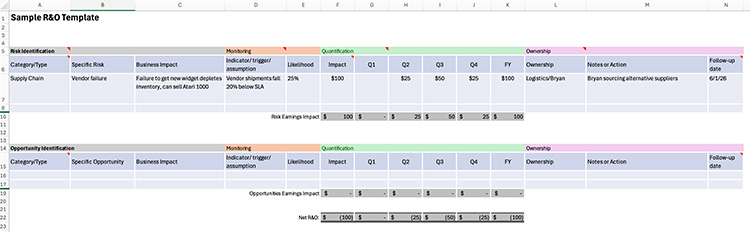
Identify, assess, monitor and develop responses to uncertainties that could affect your organization's financial performance.
Integrated Business Planning Framework
An effective integrated business planning capability is built on four connected elements:
- People: IBP relies on cross-functional teams that understand both financial outcomes and operational drivers. Finance professionals must collaborate closely with leaders across the business, applying analytical expertise while communicating insights in business-relevant terms and supporting decision-making across the enterprise.
- Process: IBP depends on structured, repeatable planning processes that connect strategy, forecasts and execution in a continuous cycle, rather than a one-time annual event. These processes ensure assumptions are aligned, plans are refreshed as conditions change and decisions are made using a shared framework.
- Technology: Scalable and secure planning tools support IBP by connecting data, models and reporting across functions. These systems enable collaboration, version control and access to trusted data while reducing manual effort and rework.
- Data: Reliable, well-defined data underpins IBP. Common definitions, shared assumptions and consistent metrics ensure decisions are based on a single, trusted version of the truth. This allows leaders to focus on decisions rather than debating numbers.
Together, these elements create a continuous planning cycle in which insights flow across the organization and plans evolve as conditions change.
Best Practices and Challenges for Integrated Business Planning
Implementing integrated business planning requires both structural and cultural change. While many organizations recognize the value of alignment, fewer have formalized the processes and behaviors needed to sustain it. Understanding common best practices and anticipating challenges can help finance teams set realistic expectations and prioritize improvements.
Best practices for IBP include:
- Establishing cross-functional collaboration across the entire enterprise and clear ownership of the planning process
- Synchronizing financial and operational planning cycles
- Using continuous forecasting and rolling updates rather than static annual plans
- Applying common data definitions and assumptions across business units
- Incorporating structured scenario planning to bring foresight (the consideration of potential futures) into the forecast (expectation of what will happen)
- Identifying risks and opportunities at multiple entity levels (corporate, unit, product/services)
More best practices for IBP can be found in the AFP FP&A Maturity Model.
Common challenges include:
- Siloed data and disconnected planning processes
- Inconsistent assumptions across departments
- Heavy reliance on spreadsheets that limit scalability and collaboration
- Implementing new technology without redesigning underlying processes
Findings from the 2025 AFP FP&A Benchmarking Survey Report suggest these challenges persist even in organizations with advanced planning tools. While technology adoption is widespread, efficiency gains have remained largely flat, indicating that tools alone are not enough. Sustainable progress requires rethinking how planning responsibilities are shared, how assumptions are governed and how insights are translated into action.
Scenario Planning Framework
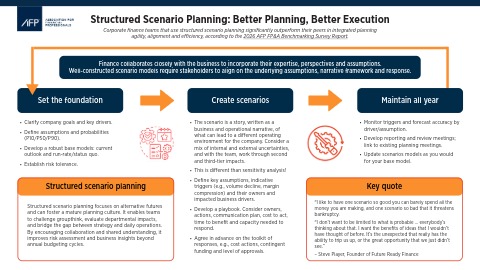
Structured scenario planning enables teams to challenge groupthink, evaluate departmental impacts, and bridge the gap between strategy and daily operations.
Technology Solutions for Implementing Integrated Business Planning
Integrated business planning is enabled by a connected technology stack, not a single tool.
- Systems of record (ERP, CRM, HR, supply chain) provide trusted actuals.
- A data integration layer standardizes definitions and assumptions.
- Enterprise planning/EPM platforms link operational drivers to financial outcomes, enabling forecasts, scenarios and trade-off analysis.
- Analytics, reporting and workflow tools make insights visible and govern collaboration.
In more mature IBP environments, advanced analytics and AI may augment every layer of the IBP tech stack; however, they don’t replace the need for integration and governance. AI only adds value when the underlying data, processes and cross-functional alignment are already in place — otherwise it accelerates noise rather than insight.
AI can enhance IBP by:
- Improving data ingestion and integration through the automation of data preparation and anomaly detection
- Improving planning platforms through predictive forecasting and scenario generation
- Strengthening analytics by surfacing insights and risks faster
- Enabling more automated workflow and decision support, reducing manual effort
Finance professionals can explore solutions for their IBP tech stack through the AFP Treasury and Finance Marketplace.
FP&A's Role in Integrated Business Planning
FP&A professionals are often the natural leaders of integrated business planning initiatives. FP&A sits at the intersection of strategy, finance and operations. Reporting up to the CFO (whose purview spans the entire enterprise, not a single business unit), the function translates business drivers into financial outcomes and helps align plans across the enterprise.
In an IBP environment, FP&A professionals:
- Serve as connectors between strategic goals and operational plans
- Own key assumptions, models and scenarios
- Facilitate cross-functional alignment and trade-off discussions
- Support leadership with forward-looking insights rather than static reports
As FP&A responsibilities expand, integrated business planning is also reshaping career paths within finance. Many professionals now spend a significant portion of their time on activities beyond traditional finance tasks, including strategy development, technology implementation and cross-functional leadership.
This shift underscores the importance of developing skills in scenario planning, communication and business partnering. Credentials such as the Certified Corporate FP&A Professional (FPAC) can help financial professionals differentiate themselves and build the capabilities needed to lead integrated planning efforts.
FAQs About Integrated Business Planning
Is integrated business planning the same as budgeting?
No. While budgeting is an important component of integrated business planning, it goes beyond annual budgets. IBP connects strategy, forecasting, operations and financial performance into a continuous planning process that evolves as conditions change.
How is integrated business planning different from traditional planning?
Traditional planning often occurs in silos, with separate processes for finance, operations and strategy. Integrated business planning aligns these activities, enabling organizations to evaluate trade-offs, assess scenarios and make decisions using shared data and assumptions.
Do small or mid-sized organizations use integrated business planning?
Yes. While the scope and tools may differ by organization size, the principles of IBP — cross-functional collaboration, consistent assumptions and forward-looking analysis — apply to organizations of all sizes.
What skills are most important for financial professionals working in IBP?
Key skills include scenario planning, data analysis, communication and business partnering. As IBP becomes more common, financial professionals who can translate insights into actionable recommendations are increasingly valuable.