


Scenario Planning

Whereas inflexible budgets are prone to breaking, scenario planning creates agility in planning and operations. It recognizes that a single-point estimate fails to capture all possible outcomes and helps finance prepare for a range of circumstances.
Growing maturity in scenario planning is setting top finance teams apart. According to the 2026 AFP FP&A Benchmarking Survey, finance teams that use structured scenario planning outperform their peers in budgeting speed, strategic alignment and effectiveness in risk management approaches.
Quick Navigation
- What Is Scenario Planning
- Why Is Scenario Planning Important
- Types of Scenario Planning
- Scenario Planning Process
- Scenario Planning Tools and Techniques
- Scenario Planning Use Cases and Examples
- Scenario Planning Best Practices
- Scenario Planning FAQs
- Scenario Planning Resources
Complimentary Scenario Planning Framework
Fill out the form below to download a complimentary infographic that breaks down structured scenario planning.
What Is Scenario Planning
Scenario planning is the process of exploring and analyzing possible future outcomes. It involves simulating how complex changes could affect the business and assessing alternative courses of action.
By showing how external forces, customer behavior, competition and internal factors may evolve — and how those shifts could influence operations, financial performance and strategic decisions — scenario planning provides a structured way for planning partners to anticipate challenges and evaluate responses.
Why Is Scenario Planning Important
In a business environment characterized by volatility, uncertainty, complexity and ambiguity (VUCA), scenario planning becomes even more important.
1. Dispels the Illusion of Control
Single-point plans provide a false sense of security by implying we have more control over the outcome than we actually do. Scenario planning forces leaders to acknowledge uncertainty, avoid overcommitting to a single narrative about the future and remain alert to alternative paths as conditions evolve.
2. Overcomes Bias and Groupthink
Organizations are subject to biases, such as optimism and overconfidence. Scenario planning forces teams to challenge projections and imagine different outcomes, preventing "groupthink" or pandering to leadership.
3. Improves Cross-Functional Collaboration
When done well, the scenario planning process helps business leaders recognize how interconnected their organization is, where cross-department support is needed and when capital should be reallocated.
The 2026 AFP FP&A Benchmarking Survey shows that organizations that practice structured scenario planning outperform those that do not. They report 14% higher strategic alignment, 13% higher external factor integration and 13% higher horizontal business alignment.
4. Builds Flexibility Through Options
Scenario planning encourages organizations to design strategies that can be expanded, delayed, scaled back or redirected as conditions change.
5. Helps Interpret Emerging Trends
Scenarios act as a framework to help leaders interpret emerging trends and unexpected events. When changes begin to align with the logic of a particular scenario, organizations are better positioned to recognize what is happening and respond sooner.
Types of Scenario Planning
Scenario planning varies based on the time horizon.
1. Long-Term Scenario Planning
- Focus: Macro trends, business model, mission and vision
- Modeling approach: May include both quantitative assessment and qualitative narratives
2. Medium-Term Scenario Planning
- Focus: Investment choices, targets, capital payouts, new markets, new products, M&A
- Modeling approach: Leverage planning models, plus scenario-specific models
Scenario Planning Process
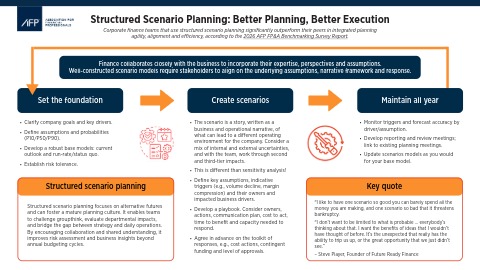
Effective scenario planning follows a structured, continuous cycle rather than being a one-time annual event.
Step 1: Develop Your Planning Base
Before exploring "what ifs," you must understand the current state of the business.
- Develop a strategic outlook: Define the company's vision and risk appetite to establish triggers and severity of reactions. Identify key assumptions, drivers (most significant and volatile impacts) and constraints.
- Develop a robust base model: Use a driver-based model for easy input adjustments and a rolling forecast to extend the scenario beyond the fiscal year.
Step 2: Create the Scenarios and Plans
- Create three to seven scenarios: This includes base case(s). Write the scenarios as stories that define a problem, e.g., "if XYZ happens, then what?"
- Model the scenarios: Convert narratives into quantitative models. This can be done by leveraging the base model and changing the key drivers and assumptions, or by developing alternative models.
- Identify leading indicators and triggers for action: Each scenario should have an external or internal measure that alerts the company when it is likely to occur.
- Create a playbook: Pre-plan responses and identify "no regrets" moves, i.e., actions that are favorable under all scenarios.
- Communicate scenarios and plans: Coordination across business groups is key to developing and reacting to scenarios.
Step 3: Maintain Throughout the Year
- Monitor leading indicators: This should be part of environmental scanning. It can become part of management reporting when it warrants management attention.
- Incorporate into reviews and reforecast cycles: Update scenarios, plans and playbooks during regular financial reviews and reforecast cycles.
- Refresh and review models: Check narratives for relevance and refresh data driving models. Ensure that plans still make sense.
Scenario Planning Tools and Techniques
Finance professionals use a wide range of tools and techniques to aid their scenario planning.
- Driver-based modeling, because it’s predicated on drivers, makes it easier to manage input adjustments, update quickly and flex drivers.
- Rolling forecasts allow the duration of scenarios to extend beyond the fiscal year.
- What-if analysis explores variations of “What could happen if…” and broadens thinking beyond fixed assumptions.
- Stress testing examines resilience in the face of severe adverse events, such as price shocks and supply failures.
- Probabilistic simulations, such as Monte Carlo, apply probability distributions to generate a full range of possible outcomes.
- Predictive planning and forecasting, which uses algorithms to derive a relationship between predictors and outcomes and project trends forward.
- Pre‑mortems imagine project failures and trace back potential root causes.
- Backcasting starts from a defined successful future and determines milestones needed to get there.
Scenario Planning Use Cases and Examples
Organizations use scenario planning to prepare for high-impact events. One example is an economic shock, such as a recession, which can simultaneously affect sales volume, pricing, material costs and workforce needs. Another is competitive disruption, such as a merger between major competitors.
Below is an overview of one financial professional’s approach to integrating scenario planning into the continuous review process:
- Annual: Complement the company’s long-range plan with "upside/downside" analysis of opportunities and risks that could impact the income statement, as well as stoplight (red/yellow/green) reporting to show performance against targets.
- Quarterly: Produce bottom-up forecasts that show its current position and internal analysis, covering the current fiscal year plus an additional six to 12 months. These scenarios are typically less detailed than those developed during the planning cycle, but they are built from scratch each time and involve significant management buy-in.
- Monthly: Produce a “flash” forecast (completed in under two weeks) to assess whether the prior forecast remains achievable. Review quarterly scenarios, apply stoplight (red/yellow/green) status indicators and flag any new developments the company should know about.
- Ad hoc: Add forecasting cycles when an emergency or unforeseen risk arises, like a major contract loss or a global event. While the long-range plan remains unchanged, with board approval, stoplight thresholds and leading indicators may be temporarily adjusted to reflect heightened risk, and performance targets may be recalculated.
Scenario Planning Best Practices
Follow these best practices to maximize the effectiveness of scenario planning:
- Be proactive: While no playbook will perfectly match every scenario, organizations can build the capability to replan quickly.
- Collaborate cross-functionally: Avoid the "worst practice" of having every department create its own scenarios; well-considered scenarios require input from different departments.
- Plan your outputs: Build visualizations and summaries into the base model to reduce preparation time, ensure consistency and make information easier to absorb.
- Establish leading indicators and triggers in advance: It’s easier to define these in times of calm rather than times of stress.
Scenario Planning FAQs
How many scenarios should we create?
Best practice is to create three to seven scenarios, including base case(s). Too few limits thinking, while too many can lead to diminishing returns.
Who should be involved in scenario planning?
While FP&A typically leads scenario planning, the process relies on input from both finance and non-finance experts to understand enterprise-wide impacts. For example, risk management and internal audit teams often provide valuable insights because they regularly address similar questions.
How often should we update our scenarios?
Best-in-class organizations maintain scenarios throughout the year, incorporating them into financial reviews and reforecast cycles.
What is the difference between scenario planning and sensitivity analysis?
Scenario planning explores multiple plausible future environments by changing several variables at once to understand how different conditions could affect outcomes. In contrast, sensitivity analysis tests how changes in a single input variable affect a model’s results, holding other factors constant.
Scenario Planning Resources
Interested in learning more about scenario planning? Check out these resources:
- Get detailed guidance on conducting scenario planning year-round with the complimentary AFP Guide to Scenario Planning, underwritten by Workday.
- Download a complimentary R&O template to help you manage risks and identify opportunities.
- Learn to develop flexible forecast models using CHOOSE for scenario planning with the AFP Digital Badge: Financial Forecasting in Excel (complimentary to AFP Members).
- Discover why many finance leaders are doing much more robust scenario planning in response to uncertainty in the article, 6 Ways Finance Leaders Are Managing Uncertainty.