

2026 AFP FP&A Benchmarking Survey Report: Integrated Planning
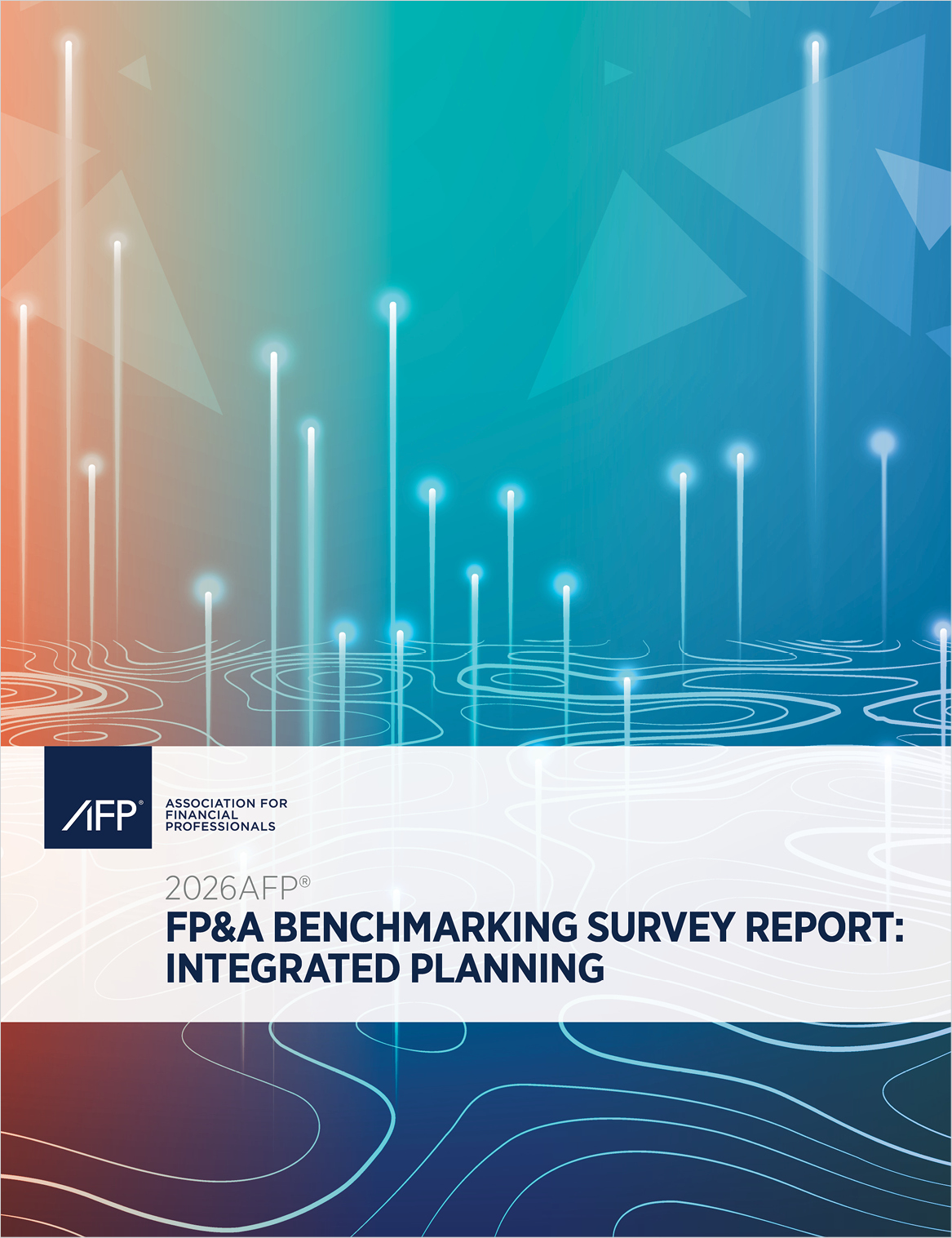
How leading finance teams connect strategy, budgeting, forecasting and execution in an increasingly volatile environment.
Integrated planning has become a defining capability for high-performing FP&A teams—but many organizations are still struggling to translate strategy into execution. The 2026 AFP® FP&A Benchmarking Survey Report: Integrated Planning delivers data-driven insights from 332 FP&A and finance professionals across 54 countries, revealing how organizations approach scenario planning, budgeting, forecasting and risk management—and where gaps persist between intent and outcomes.
This report is essential reading for FP&A leaders, finance managers, directors and CFOs seeking to improve planning maturity, strengthen cross-functional alignment and build more agile, resilient finance functions.
Explore: What You’ll Learn from the 2026 FP&A Benchmarking Survey | Data Highlights | Who Should Read This Report? | Why Integrated Planning Still Falls Short | Press Information
Download the Survey Report:
To access the report findings, please fill out the form below:
What You’ll Learn from the 2026 FP&A Benchmarking Survey
Report Includes
- How structured scenario planning drives stronger alignment, faster budgeting cycles and higher planning maturity
- Why risk and opportunity management is now a core FP&A responsibility—not a side activity
- Where budgeting and integrated planning break down during execution, despite strong leadership alignment
- How FP&A roles are expanding beyond finance into strategy, technology, operations and leadership
- Why investments in planning technology have not yet delivered expected efficiency gains—and what to do next
Data Highlights
- Only 38% of organizations use structured scenario planning, yet those that do show significantly higher effectiveness across planning dimensions
- Organizations using structured scenario planning complete budgets 11% faster on average
- 90% of finance teams manage risks and opportunities, but fewer formalize those insights into integrated planning processes
- Budget alignment is strongest at the executive level, while horizontal and operational alignment lag behind
- Despite widespread adoption of planning tools, the average budgeting cycle still takes nearly nine weeks, unchanged over three years
Who Should Read This Report?
This benchmarking report is designed for:
- FP&A analysts, managers, and directors
- Heads of FP&A and finance transformation leaders
- CFOs and senior finance executives
- Finance professionals responsible for budgeting, forecasting, rolling forecasts, and integrated planning
- Organizations evaluating or optimizing enterprise planning and performance management processes
Why Integrated Planning Still Falls Short
The findings show a clear pattern: while organizations have embraced new planning technologies and recognize the strategic value of integrated planning, process design, skill development and execution discipline have not kept pace. Integrated planning succeeds only when people, process and technology evolve together. Without that alignment, even the best tools fail to deliver measurable ROI.
This report is part of a three-year FP&A Benchmarking series, which explores key themes in FP&A staffing, technology, and planning. Each year focuses on a distinct topic, and together they provide a comprehensive view of FP&A practices. The other reports in this series are:
Press Information
Press Release: AFP Survey Reveals Structured Scenario Planning Separates Top Performing Corporate Finance Teams
If you are interested in referencing data from this report in marketing materials, etc. please contact Anissa Holm, Research Manager.
Contact [email protected] or call 301.907.2862 for more in-depth information, to read the full report or to arrange an interview with AFP Research.
Learn more about AFP member benefits and join today.
Questions about this subject?

Contact Bryan Lapidus, FPAC,
AFP's Director of FP&A Practice