


Prescriptive Analytics

Today’s office of the CFO is expected to be a strategic partner to the business, going beyond historical reporting to drive profitable growth. As the forward-looking engine of finance, the financial planning and analysis (FP&A) function is particularly well-positioned to make data-driven recommendations on how organizations should allocate resources and prepare for what's next.
Taking a proactive approach to finance necessitates a new suite of powerful tools that enable FP&A professionals to anticipate challenges and opportunities and make informed decisions. One such tool is prescriptive analytics, which answers one of the most critical business questions: “What should we do?”
This article explores what prescriptive analytics is and its importance for the office of the CFO, and provides concrete examples for FP&A.
Quick Navigation
- The Analytics Continuum
- Prescriptive vs. Predictive Analytics
- Use Cases for Prescriptive Analytics in FP&A
- Best Practices for Implementing Prescriptive Analytics in FP&A
- Upskilling for Prescriptive Analytics in FP&A
What Is Prescriptive Analytics? Meaning, Definition & Importance in Finance
Prescriptive analytics is a subset of business analytics that uses statistical techniques, machine learning (ML) algorithms and business rules to analyze data and recommend the best course of action, based on predefined outcomes that should be maximized. The use of ML algorithms makes it possible for prescriptive analytics to uncover complex relationships within data that humans may find difficult to recognize.
Humans have a limited cognitive capacity to parse large amounts of data; the data processing power of prescriptive analytics allows it to analyze large datasets and consider a range of possibilities much more quickly than humans can. This speed enables prescriptive analytics to respond to rapid changes in dynamic environments, facilitating faster decision-making with the most up-to-date information.
In finance, prescriptive analytics provides a competitive advantage by helping financial professionals proactively mitigate risks, optimize resource allocation, improve operational efficiency and ultimately enhance profitability.
When leveraging prescriptive analytics tools, the first step is to define the problem and determine what “success” looks like. This instructs the ML algorithms on what they should achieve and guides the choice of model and data required for optimal results.
The next step is to train the ML algorithms on datasets so they can identify patterns, relationships and trends within the data. Once trained, they can perform predictive analytics and forecast potential future outcomes.
Prescriptive analytics aims to find the most favorable combination of likely outcomes and their associated benefits, while minimizing drawbacks. To accomplish this, it combines the forecasts from predictive models with:
- Simulation modeling, which provides the probability of potential outcomes for a specific course of action, as well as the potential risks and rewards associated with it
- Business rules, which act as specific criteria to guide decision-making in alignment with business objectives and constraints
- Optimization modeling, which aims to find the best possible solution given a specific goal and set of constraints
The result is an actionable recommendation that is tailored to a specific situation and designed to achieve a particular outcome.
The Analytics Continuum
To grasp the strategic value of prescriptive analytics, it's helpful to understand the full spectrum of data analytics. A useful framework to see the progression from basic reporting to strategic foresight is the Gartner Analytic Ascendancy Model.
- Descriptive Analytics: “What happened?” This essential step is the foundation of all financial reporting. It's purely retrospective and includes financial statements, key performance indicator dashboards and sales reports that summarize past performance.
- Diagnostic Analytics: “Why did it happen?” This step examines the data to understand the root causes behind the numbers. Using variance analysis to understand why a company spent more on raw materials for a product than was originally budgeted is an example of diagnostic analytics.
- Predictive Analytics: “What is likely to happen?” This step marks the transition from a reactive to a proactive approach, using historical data, statistical algorithms and machine learning to forecast future outcomes.
- Prescriptive Analytics: “What should we do?” This step uses the forecast from predictive analytics to recommend specific optimal actions that will achieve a desired outcome.
These four points on the spectrum mirror what the CFO is trying to accomplish in general, moving from a rear-view recorder of transactions to a forward-looking strategist. Adding automation in the form of prescriptive analytics accelerates FP&A's ability to provide that service to the business.
Prescriptive vs. Predictive Analytics
Financial professionals need to understand the differences between prescriptive and predictive analytics to use them most effectively in their work:
- Predictive analytics provides foresight of likely outcomes through outputs such as forecasts, probabilities and scores.
- Prescriptive analytics provides guidance, recommending a specific optimal action to the financial professional. To do this, it needs the output from predictive models.
A head-to-head comparison:
| Predictive Analytics | Prescriptive Analytics | |
| Core Question | What is likely to happen? | What should we do? |
| Primary Output | Forecast, probability, score | Actionable recommendation |
| Human Role | Interpret the forecast and decide on how to act on the information | Augment recommendation and oversee automated decisions |
Use Cases for Prescriptive Analytics in FP&A
Enhanced Scenario Planning
Prescriptive analytics elevates scenario planning from “what if?” to “what's best?” A prescriptive model can take a comprehensive view of the business and broader economic landscape to consider the connections between numerous factors, simulate thousands of potential outcomes, quantify the risks and opportunities and identify the optimal approach. It can work through these scenarios during strategic planning and also in rapid response to fast-moving events and business results.
Optimized Resource and Capital Allocation
For companies with multiple products or locations that each have unique costs and constraints, determining ways to improve operational efficiency and cost effectiveness can be an incredibly complex task. A prescriptive model can consider all the relevant data to evaluate trade-offs and recommend an optimal course of action to improve profitability.
Best Practices for Implementing Prescriptive Analytics in FP&A
Adopting prescriptive analytics goes beyond technology implementation. Below are five best practices to follow when implementing prescriptive analytics in FP&A:
- Choose a manageable, well-defined scope for the pilot. As the AFP FP&A Guide to AI-Powered Finance advises, starting with a small yet high-impact project can demonstrate the value of the technology and garner support for it. Set a SMART goal (specific, measurable, achievable, relevant, time-bound) to ensure the project delivers quantifiable value.
- Clean and consolidate data. A lack of reliable and accessible data will hold back even the most advanced prescriptive analytics tool. Implement data cleaning, validation and standardization processes to improve data quality. Additionally, connect disparate data sources to ensure smooth data flow between operational systems and analytics platforms.
- Build trust and ownership by involving end-users in the model design and validation process. Apply explainable AI (XAI) techniques to the model to increase transparency around its output and make its recommendations more understandable.
- Maintain human oversight. Empower teams to act as the final arbiter of any decision and emphasize that the tool is meant to augment, not replace, human expertise.
- Review and test the model after implementation. Ensure it does not stray from its benchmarks and make adjustments as needed.
Upskilling for Prescriptive Analytics in FP&A
FP&A professionals seeking to harness the power of prescriptive analytics will need to combine their financial acumen with advanced analytical capabilities, strong data literacy and enhanced communication skills.
Analytical Skills: The “What and Why”
As the connection between finance and business execution, FP&A professionals need to ensure that data is being interpreted within the proper business context to produce meaningful insights.
- Financial and business acumen are critical to developing relevant models that reflect business realities. FP&A professionals need to understand how financial metrics and operational drivers interact and have a thorough grasp on the company’s operations, market dynamics and competitive landscape.
- Critical thinking skills are necessary to know which questions to pursue using prescriptive analytics and to interrogate assumptions and outcomes.
- Statistics fundamentals are needed to understand the accuracy of a model and identify potential flaws and limitations.
Technical Skills: The “How”
Complex data and sophisticated models are at the heart of prescriptive analytics. While most FP&A professionals are not yet likely to build prescriptive analytics tools themselves, having a functional understanding of the related technologies can be helpful.
- Data wrangling skills, including proficiency in database query languages, such as Structured Query Language (SQL), as well as some BI tools and other wrangling tools, are necessary for gathering and preparing data from multiple sources.
- Basic knowledge of programming languages, such as Python or R, is optional but enables more advanced data manipulation, analysis and model development. For those without coding skills, an AI-powered process, such as the one described in the AFP article “How Financial Professionals Can Apply GenAI to Data Workflows,” can be used to generate code for data processing needs.
- Knowledge of optimization algorithms and simulation modeling is essential for understanding how prescriptive analytics works. Optimization algorithms are used to identify an optimal solution among various alternatives, taking into consideration objectives and constraints. Simulation modeling is employed to account for real-world uncertainty, providing a range of potential risks and rewards for different courses of action.
- Proficiency in business intelligence (BI) and data visualization tools is necessary for analyzing and visualizing insights derived from prescriptive models.
Soft Skills: The “So What”
Analytical findings will fail to influence change if the decision-makers cannot understand them. The responsibility lies with FP&A professionals to communicate effectively.
- Communication and data storytelling skills are essential for translating complex analytical findings into a compelling business narrative that resonates with non-technical stakeholders and addresses their concerns. People often perceive prescriptive analytics as a mysterious black box; FP&A professionals need to explain the rationale behind the recommendations.
- Collaboration and business partnering skills are critical for working with teams across the company to gather relevant data, understand business processes and ensure recommendations are feasible.
A Culture of Continuous Learning
Prescriptive analytics is constantly evolving with the ever-growing innovations in AI and ML. To stay current, FP&A professionals need to maintain a mindset of continuous learning. Opportunities for professional development include:
AFP FP&A Series: No-Code AI for Finance: A complimentary virtual event taking place August 27, 11:00 AM - 3:00 PM ET, designed to help FP&A professionals harness the power of generative AI, machine learning and intelligent agents.
AFP Digital Badge: Analytics for Finance: Build the foundation for more advanced analytics. Learn about data cleanliness, data clustering and data visualization.
![UMB Bank Vert Full Color CMYK[2]](/images/default-source/article-images/interpayments-logo_png.png?sfvrsn=4213fb6b_1 "Interpayments Logo")
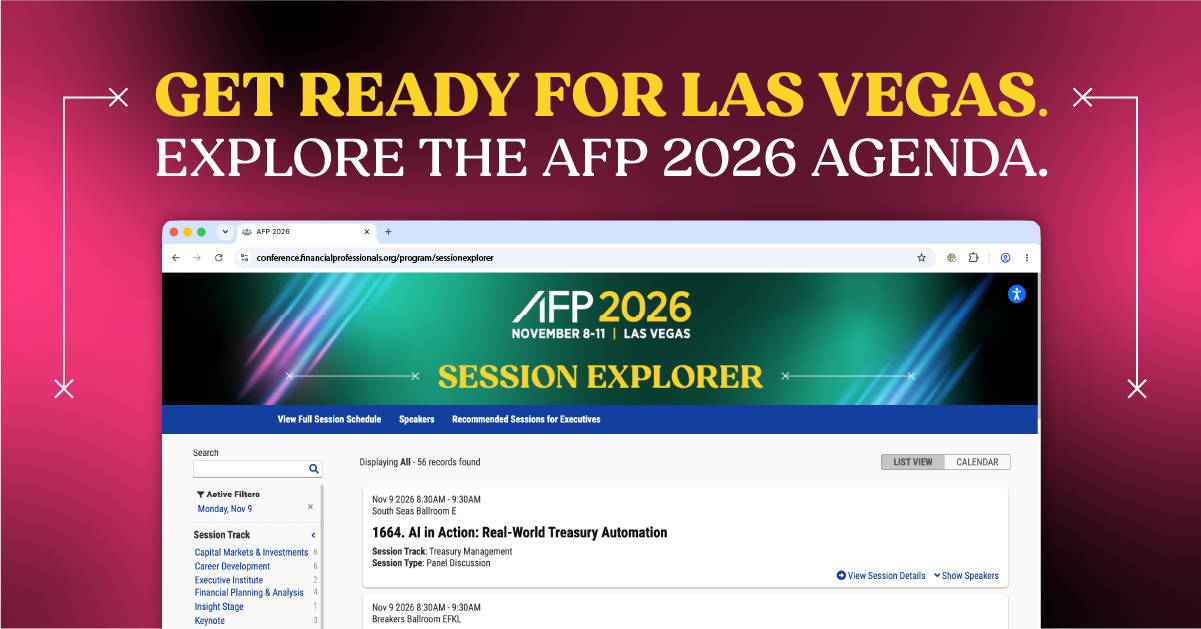
🔍 Browse 140+ sessions by day or track
💡 Discover the speakers sharing
real-world treasury and finance strategies
🤝 Find networking experiences designed
to help you connect with peers
📅 Build your plan before you arrive
Start Exploring