


Articles
How Finance Can Help Department Managers Become Better Stewards of Their Budgets
- By AFP Staff
- Published: 4/10/2026

At many organizations, the budget is clear at the top. Leadership aligns around strategy, finance builds the plan and the numbers make sense. But that alignment weakens as the strategy moves down the org chart to those who make it work.
A majority of respondents (63%) to the 2026 AFP FP&A Benchmarking Survey say that their planning aligns well with strategic goals. However, they report weaker execution across the organization, with fewer than half (47%) using consistent assumptions and variables. Furthermore, only 46% of respondents feel they have horizontal alignment across business operations.
The results indicate a disconnect between what the budget is meant to do and how it’s actually used. So, how can finance close that gap? Members of the FP&A Advisory Council point to a handful of practical shifts that can make budgets more actionable, more relevant and, ultimately, more effective.
Treat the budget like a plan, not a list
One of the biggest challenges in execution is that budgets often start (and remain) as static documents. Instead, they should function as operational plans.
“Treat your budget as a mini business case with explicit drivers and ‘if-then’ commitments, not as a list of line items,” said finance leader Julián Scutari. “That makes it defendable up front and executable all year.”
It’s a shift that changes everything. Rather than focusing only on dollars, strong budget owners:
- Anchor spending in outcomes and strategic alignment.
- Tie dollars to specific drivers they can control.
- Make trade-offs explicit before decisions are made.
When a budget is built this way, execution becomes clearer because the underlying logic is visible.
Focus on outcomes, not just staying “within budget”
For many department managers, success is defined too narrowly: don’t overspend. But staying within budget doesn’t necessarily mean delivering value.
“Mindshift changes behavior: Prioritize return on investment instead of staying ‘within budget,’” said Haresh Vayal, CFO of American Councils for International Education.
This mindset aligns more closely with how leadership views the budget — as a tool for achieving outcomes, not just controlling costs. It also helps address one of the core challenges identified in AFP’s survey: making budgets feel relevant to business units rather than restrictive.
Make the budget understandable and usable
Another key barrier to execution is that not everyone “speaks finance.” Many budget owners come from operations, marketing or production — not FP&A. If the budget doesn’t resonate with them, it won’t be used effectively.
“Know your audience. Educate your audience. Be available for your audience. Communicate in a manner that resonates with them,” said one senior practitioner.
This is where FP&A plays a critical role. AFP’s survey highlights that while communication with leadership is strong, it breaks down across teams. Bridging that gap requires translating financial plans into operational terms — using language, metrics and visuals that business partners can act on.
Stay ahead of the numbers
Execution improves when there are fewer surprises. That means shifting from reactive reporting to proactive management.
“Be able to predict where you will land before actuals post, so there are no surprises,” said Jermaine Stanislaus, Senior Financial Analyst.
Danny Shiu added, “Track spending against the budget continuously, and update your rolling budget after each month closes so it reflects the most current year-to-date sales trends.”
Together, these practices reinforce a key principle: Budgets shouldn’t be reviewed after the fact; they should be actively managed throughout the year.
Risk and Opportunity Template
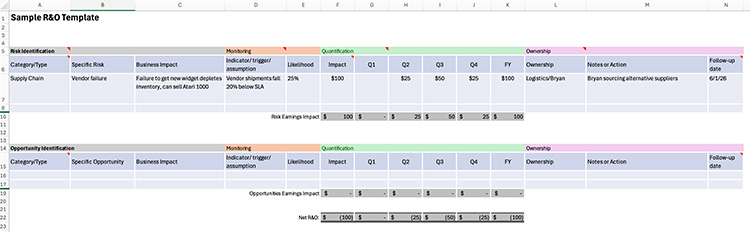
Identifying potential risks and opportunities during the budgeting process — and monitoring them year-round — provides visibility into events on the horizon and allows you to plan responses.
Bring a broader perspective to every decision
Budgets don’t exist in a vacuum, but they’re often managed that way. Jeff Zielinski, CFO of Buy&Ship, emphasizes working across silos.
“Work relentlessly to bring different perspectives,” he said. “Bring an enterprise-level perspective … [and] multi-year perspectives also.”
This is critical for addressing weak horizontal alignment across business units. When department managers understand how their decisions affect the broader organization — and future periods — they make better trade-offs in the present.
Make performance visible and shared
Finally, execution improves when the budget is visible, not buried in spreadsheets.
“Create a way to make the budget visual for leaders, and updated weekly/monthly with actuals,” said Tyler Vonderheide, Senior Manager of FP&A Systems at Southwest Airlines.
Others reinforced the importance of rhythm and accountability. “Review your budget performance with your team every month,” said another senior practitioner.
Visibility drives ownership, ownership drives better decisions, and over time, that consistency helps close the gap between planning and execution.
Turning strategy into action
At its best, the budget acts as a bridge, connecting strategy to execution. Improving budget stewardship is about making the budget:
- Clearer: Linked to outcomes and drivers
- More relevant: Aligned with how teams actually work
- More dynamic: Actively managed, not passively reviewed
Put more simply: a budget people can use — not just one they’re expected to follow.
Copyright © 2026 Association for Financial Professionals, Inc.
All rights reserved.
🔍 Browse 140+ sessions by day or track
💡 Discover the speakers sharing
real-world treasury and finance strategies
🤝 Find networking experiences designed
to help you connect with peers
📅 Build your plan before you arrive
Start Exploring
AFP Membership
The Hub for Treasury and Finance Professionals
As an AFP member, you'll gain access to exclusive training, certifications, research and networking to advance your career.
AFP Newsletters
Unbiased, practitioner-driven information for treasury and finance professionals
Subscribe to an AFP Newsletter to receive the latest news, events and trends in FP&A, Treasury or career planning.