


Articles
How to Choose the Right Rollout Strategy for a Transformation Initiative
- By AFP Staff
- Published: 1/27/2026

Choosing the right rollout strategy can make or break a transformation initiative. At a recent AFP Tech & Change Management Meet-Up, finance leaders discussed how to decide on a rollout strategy for a transformation initiative and evaluate when a pilot has done its job. Below are highlights from the discussion.
3 types of rollout strategies
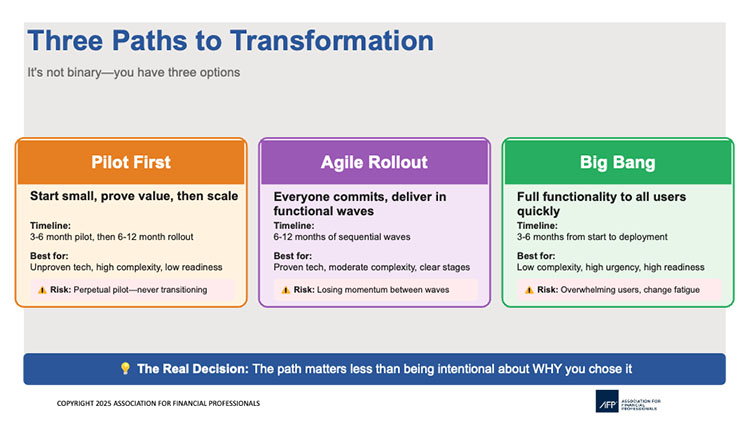
The group discussed three common rollout strategies for transformation initiatives — Pilot, Agile Rollout and Big Bang — emphasizing that no single approach is universally right or wrong. Each strategy has the potential to succeed or fail, depending on the organization’s context and readiness for change.
To help teams make intentional choices, Mitch Max, AFP’s Executive in Residence, introduced a five-decision factor framework designed to guide rollout decisions. Rather than defaulting to a one-size-fits-all approach, the framework encourages leaders to assess the conditions surrounding a transformation before selecting a strategy.
Using this lens, the meet-up participants explored how each rollout approach aligns with different organizational needs:
- A Pilot rollout allows teams to start small, test changes and refine processes in defined areas before scaling up, making it well-suited for environments with lower readiness, tighter resources or limited risk tolerance.
- An Agile rollout delivers functionality in sequential waves, balancing momentum with flexibility, allowing teams to adjust as they learn.
- A Big Bang rollout, delivering all functionality to all users, while riskier, can be effective for organizations with high readiness, strong resources and urgent timelines, such as system sunsets or regulatory deadlines.
The five-decision factor framework helps organizations evaluate which approach best fits their situation. The image below presents each factor with a high-to-low position.
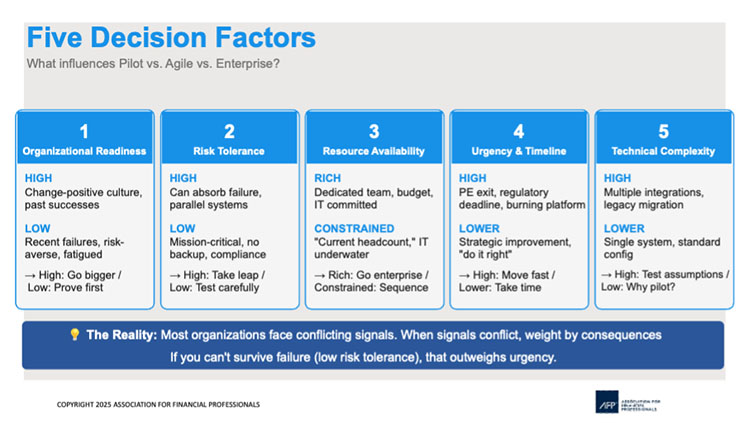
Companies that assess themselves as high might opt for a big-bang or enterprise deployment; companies that assess themselves as low might mitigate their risk with a pilot path. These factors are a subset of broader organizational readiness factors that apply to all delivery models.
- Organizational readiness, including culture, past successes or failures and openness to change
- Risk tolerance, or how much disruption the organization can absorb
- Resource availability, including dedicated staff, budget and IT support
- Urgency and timeline, such as external deadlines or business pressures
- Technical complexity, including integrations, migrations and system dependencies
Note that Agile deployments don’t exactly fit on this scale. Agile is an alternate approach that is more functional in orientation than breadth of implementation; it focuses on improving how work gets done rather than trying to overhaul every part of an organization at once. Instead of implementing a large, enterprise-wide transformation, Agile zeroes in on delivering specific functionality, workflows or processes to create value in waves. In other words, it’s about depth of functionality — tight feedback loops, faster cycles, clearer roles — rather than broad scope or sweeping, organization-wide change.
By assessing these factors together, leaders can better anticipate challenges, align expectations and select a rollout strategy that supports sustainable, successful transformation.
How to know when a pilot has done its job
One of the most challenging aspects of running a pilot during a transformation initiative is determining when it’s truly done. Teams often feel pressure to keep refining and perfecting, but without clear criteria for completion, pilots can stretch on indefinitely. Defining success up front helps ensure the pilot delivers actionable insight — not just incremental improvement — for the next phase.
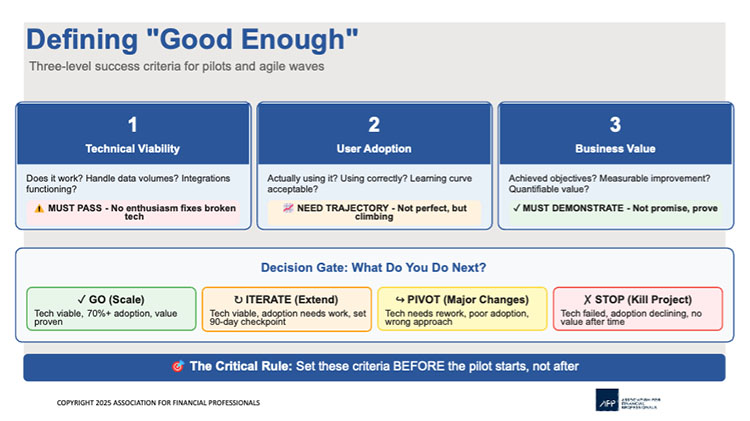
Participants identified three essential criteria for evaluating whether a pilot is complete:
- Technical viability: The solution must function reliably and integrate properly, with major technical issues resolved before moving forward.
- User adoption: The pilot should demonstrate that users are engaging with the new process or tool and that adoption is trending in the right direction, even if some aspects can be improved over time.
- Business value: The pilot should demonstrate measurable business value or clear progress toward organizational objectives, even if full value isn’t realized in the pilot phase.
Critically, these criteria should be defined before the pilot begins. Doing so allows teams to make informed decisions about whether to proceed, iterate or stop — and prevents pilots from becoming open-ended experiments that delay meaningful change.
Learn more
Sign up for the next AFP Tech & Change Management Meet-Up, complimentary to AFP Members.
Read related content:
- How Finance Teams Navigate Change and Build Momentum
- AFP FP&A Guide: Get Your Data Right, underwritten by Workday
- AFP Guide: Implementing Planning System: Part 1, Laying The Groundwork, underwritten by Adaptive Insights
- AFP Guide: Selecting Planning Software (Part 2)
Copyright © 2026 Association for Financial Professionals, Inc.
All rights reserved.