

Articles
How Finance Teams Navigate Change and Build Momentum
- By AFP Staff
- Published: 1/28/2026

For finance teams, transformation rarely happens all at once. It unfolds over time — shaped by new technologies, shifting expectations and the need to balance progress with day-to-day realities. Success depends on more than tools alone; it requires clear communication, shared alignment and thoughtful execution.
The AFP Tech & Change Management Meet-Up series focuses on how organizations approach this challenge in practice. During the December meeting, the group discussed how teams assess their readiness for change, rally around new initiatives and select rollout strategies that align with their culture and constraints. The insights shared below offer practical guidance for finance leaders at any stage of their transformation journey.
Transformation in practice — start, sustain, start again
When Mitch Max, AFP’s Executive in Residence, asked the group where they were in their transformation efforts, most meet-up participants said they were either at the beginning of the journey or in a post-implementation phase focused on sustaining change. The highlight of the discussion, however, was the fact that transformation is rarely a linear process.
Instead, it is a continuous cycle, with teams often planning, executing, measuring and course-correcting in an ongoing loop. Comments from the group emphasized that change is ongoing rather than episodic, with organizations frequently experiencing multiple stages simultaneously.
This continuous cycle can lead to “change fatigue” — the need to continually improve and refine how the work gets done instead of settling into a rhythm to do the work. This is particularly exhausting, they said, with the rapid evolution of technology and the introduction of AI. While technology is often the driver, pushed by external voices of consultants and tech chatter, it comes with changes in job responsibilities, process flows and the content of the work itself.
What employees hear when leaders talk about change
Executives and managers regularly frame transformation as a path to greater efficiency and productivity, according to the meet-up participants. A common refrain is "Efficiency, efficiency, efficiency!" When emphasized without context, however, it is often interpreted as a threat to job security rather than opportunity — particularly with the increasing presence of AI and automation in the workplace.
When communicated well, the narrative around transformation shifts from simply processing numbers to enabling deeper analysis and providing actionable insights, placing greater emphasis on the opportunity for finance teams to add value. This approach encourages finance professionals to move beyond routine tasks and become strategic partners who contribute meaningfully to organizational success.
Recognizing the layers of communication
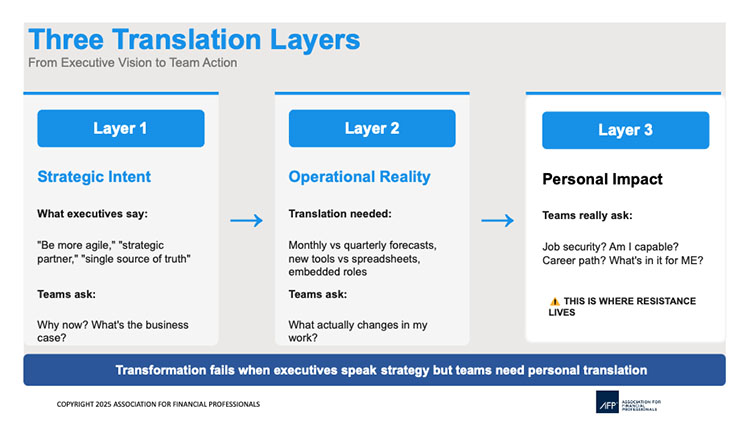
In the transformation journey, effective communication must bridge three distinct layers: strategic intent, operational reality and personal impact. There is often a gap between what leadership envisions and how teams interpret those goals, i.e., strategic intent.
“Executives say, ‘Be more agile, be a strategic partner, have a single source of truth.’ But teams want to know why? Why is this important to me?” said Max.
Operational reality is where strategy meets the day-to-day work. It’s where the practical implications of transformation are felt, often leading to anxiety about increased workload or new processes.
“This is how people engage. Tactically, it might mean monthly forecasts instead of quarterly, spreadsheets moving to new tools. People are asking, how does this change the work I do?” said Max.
The deepest layer is personal impact. “This is where employees ask, what is my job? Can I do this job as I foresee it? Am I skilled at this level? It’s where resistance lives,” said Max. Transformation efforts can falter if leaders fail to address these personal concerns.
By recognizing and communicating across all three layers, organizations can reduce resistance and foster engagement, helping teams see transformation as an opportunity rather than a threat.
A question of capacity
A second poll asked participants to assess their team's capacity to take on something new. What was revealed is that most teams feel stretched, describing their current workload as “tight but manageable if the thing is right,” while others admitted they are “overcapacity” and would need to stop doing something else to take on new projects.
The discussion underscored a familiar reality for finance teams: They often operate at or beyond full capacity, juggling recurring tasks — such as reporting and board packs — while also being expected to drive change. The cyclical nature of financial work makes it difficult to find time for transformation because, when a team generates momentum, it is often interrupted by a close or planning cycle.
Still, optimism remained high. Nearly half of the respondents said they would make time for the right project, even if it required extra effort in the short term. Attendees said they would make time for initiatives that promised meaningful improvement or time savings.
Building momentum through communication and trust
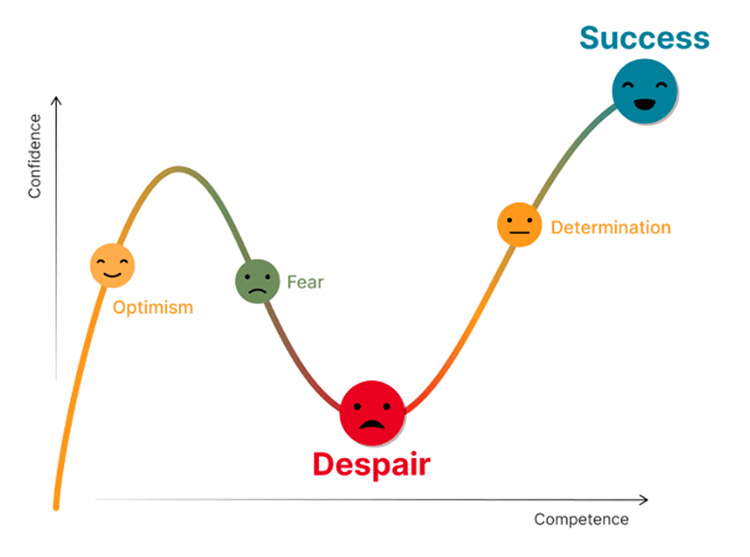
Leaders and teams should acknowledge that most projects face the dreaded “valley of despair” — the phase in which early excitement gives way to doubt and progress feels slow. A visual shared during the session illustrated how projects often move from initial optimism through fear and despair before reaching success. The conversation turned to overcoming this challenge by reinforcing the need for clarity, alignment and regular communication throughout the journey.
Building momentum starts with clear communication — sharing the vision and helping people understand the “why” behind a project. Participants emphasized the importance of listening to team members’ pain points and connecting those concerns to the value of the initiative, making the case for how transformation can benefit both the organization and individual careers.
Transparency, honesty about goals and involving the team early — especially those closest to the work — were highlighted as critical for buy-in and engagement.
The group also discussed the value of celebrating wins, showing progress and mapping achievements back to business priorities, to generate momentum. Quick wins, in particular, help maintain optimism and determination.
However, without ongoing support, that momentum can fade. Structures such as steering committees can help prevent this by providing resources, clearing obstacles and acting as visible champions for the work.
Learn more
Sign up for the next AFP Tech & Change Management Meet-Up, complimentary to AFP Members.
Read related content:
- How to Choose the Right Rollout Strategy for a Transformation Initiative
- AFP FP&A Guide: Get Your Data Right, underwritten by Workday
- AFP Guide: Implementing Planning System: Part 1, Laying The Groundwork, underwritten by Adaptive Insights
- AFP Guide: Selecting Planning Software (Part 2)
Copyright © 2026 Association for Financial Professionals, Inc.
All rights reserved.
🔍 Browse 140+ sessions by day or track
💡 Discover the speakers sharing
real-world treasury and finance strategies
🤝 Find networking experiences designed
to help you connect with peers
📅 Build your plan before you arrive
Start Exploring
AFP Membership
The Hub for Treasury and Finance Professionals
As an AFP member, you'll gain access to exclusive training, certifications, research and networking to advance your career.
AFP Newsletters
Unbiased, practitioner-driven information for treasury and finance professionals
Subscribe to an AFP Newsletter to receive the latest news, events and trends in FP&A, Treasury or career planning.