

Build the context and confidence you need to evaluate how stablecoins fit into your treasury strategy and operations.
Designed for today’s corporate treasurer, this certificate helps professionals build practical knowledge of stablecoins and their growing role in finance.
The program covers foundational concepts, treasury use cases, risk and governance considerations and operational implications for finance teams.
Developed by AFP in collaboration with Kyriba, with contributions from Circle and PwC. Explore the presenters and industry experts behind the program ↓
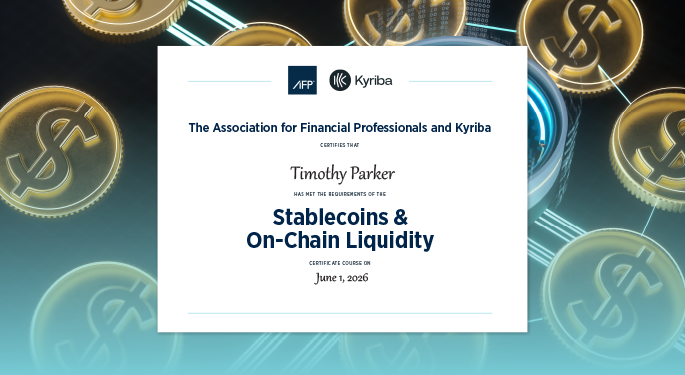
- Learn how stablecoins work in treasury terms, including issuance, redemption, reserve backing and key risks
- Evaluate stablecoin payments and on-chain liquidity models through the lens of governance, controls, auditability and operational readiness
- Understand how new payment rails can affect cross-border payments, intercompany funding, receivables, reporting and reconciliation
- Build a practical framework to assess treasury use cases, identify readiness gaps and determine pilot opportunities
The Stablecoins & On-Chain Liquidity Certificate launches in June 2026. Join the waitlist to be notified when it releases.
PROGRAM OVERVIEW
Earn up to approximately 7.8 CTP credits.
Module 1: Stablecoins in Treasury, Why This Matters Now
Introduces the topic from a treasury perspective and equips teams with the core concepts, terminology and use cases needed for informed internal discussions.
Certificate holders will be able to:
- Define stablecoins in treasury terms, including claims, redemption paths, reserve backing and control implications
- Explain how fiat-backed stablecoins maintain a peg and identify where peg risk can emerge
- Distinguish stablecoins from cryptocurrencies, tokenized deposits and traditional bank money
- Identify treasury use cases for stablecoins, including cross-border payments, intercompany flows and always-on liquidity
- Ask the right questions about settlement, governance, counterparties, controls and audit readiness
Module 2: Instruments, Risks, Governance, Policy and Security
Examines how treasury teams hold, govern, and assess digital value instruments across design, custody, risk, controls, policy and security.
Certificate holders will be able to:
- Compare stablecoins, tokenized deposits and other digital value instruments in treasury terms
- Evaluate the issuer structure, reserve transparency, liquidity access and redemption considerations
- Assess custody models, key management approaches and segregation of duties requirements
- Identify the treasury policy and governance updates needed for new payment rails and digital instruments
- Define the monitoring, recordkeeping and control expectations required for compliance and auditability
Module 3: Treasury Operations on New Rails
Turns concepts into practical treasury workflows, focusing on payments, receivables, integration, reporting, reconciliation and programmability.
Certificate holders will be able to:
- Compare traditional bank rails and stablecoin rails in terms of timing, transparency, traceability, and control implications
- Map the end-to-end flow of an on-chain payment or receivable from initiation through settlement and reconciliation
- Understand how blockchain transaction activity translates into approvals, audit trails, reconciliations, and GL support
- Identify the operational changes treasury teams may need across payables, receivables, reporting, and exception handling
- Evaluate where on-chain workflows can improve speed, visibility, and programmability in treasury operations
Module 4: Suitability, Readiness, Pilot Design and Next Steps
Helps treasury teams move from understanding to action by providing a framework to assess stablecoin use cases, required capabilities and a disciplined first phase.
Certificate holders will be able to:
- Assess whether a stablecoin use case aligns with the organization’s treasury priorities, operating model and risk appetite
- Use a readiness scorecard to identify gaps across policy, process, technology, controls and stakeholder alignment
- Design a governed pilot with clear ownership, milestones, key performance indicators (KPIs) and success criteria
- Prepare concise briefing materials for executives and the board to support internal decision-making
- Recognize common failure modes and define the controls and escalation paths that should address them
HOW IT WORKS
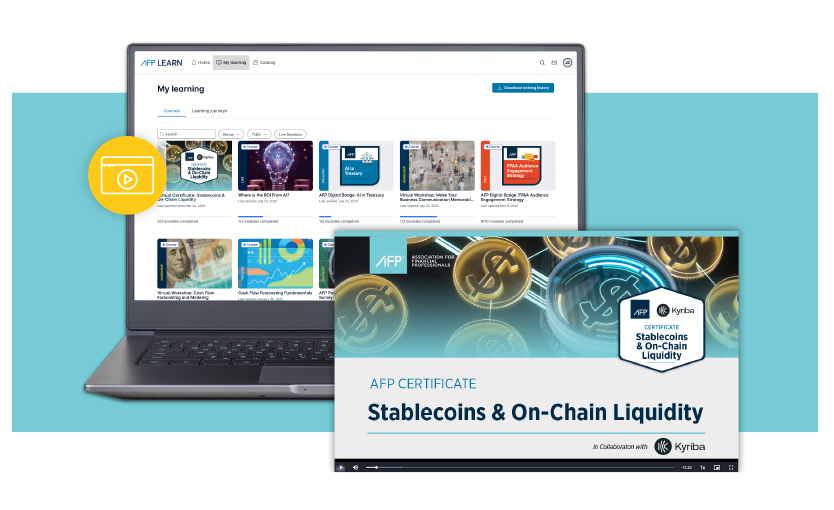
- Once registered for the Stablecoins & On-Chain Liquidity Certificate, you’ll find the course in AFP Learn under My Learning.
- Complete all four modules and pass the corresponding module quizzes.
- Within 72 hours, you’ll receive a Digital Badge and a printable certificate.
Presenters
Tom Hunt, CTP
Director, Treasury Practice, AFP
Tom is the staff subject matter expert on bank relationship management, cash management and treasury technology. He is in charge of AFP's Treasury Advisory Group; AFP's member committee dedicated to meeting the needs of the profession and helping keep members current on developing topics.
Bob Stark
Head of Market Strategy, Kyriba
Bob brings a treasury-first perspective to stablecoins, digital payments and liquidity innovation. He helps finance and treasury teams understand how new payment rails affect control, visibility, working capital and treasury operating models, with a focus on practical decision making, governance and enterprise readiness.
Jean-Baptiste Gaudemet
SVP Strategic Innovation Lab, Kyriba
Jean-Baptiste focuses on digital assets, tokenized money, stablecoin infrastructure and next-generation treasury technology. He brings deep expertise in stablecoin mechanics, on-chain liquidity and the governance and security considerations treasury teams must understand before adopting new forms of digital value.
Dory Malouf
Senior Director, Value Engineering, Kyriba
Dory helps organizations translate complex innovation topics into practical treasury decisions and operating models. His work focuses on workflow design, value realization and readiness assessment, helping treasury teams understand how new rails affect execution, controls, reporting and day-to-day operations.
Tom Gavaghan
SVP Product Strategy, Kyriba
Tom focuses on the future of treasury operations and how new technologies fit within enterprise priorities, governance frameworks and operating models. He helps treasury leaders move from market interest to disciplined action through structured readiness, pilot planning and executive-level decision frameworks.
Dan Fishman
Treasurer, Circle
Dan brings expertise in the role of regulated stablecoins in modern financial markets. He helps treasury and finance professionals understand how stablecoin infrastructure works in practice, including issuance, redemption, transparency and ecosystem adoption.
Matthew Blumenfeld
Global and US Digital Assets Lead, PwC
Matt is a Partner at PwC leading the Global and US Digital Asset teams. He brings 15 years of financial services experience across risk, regulation and transformation, advising institutions on digital asset strategy, custody, tokenization and blockchain integration while bridging traditional finance and emerging crypto ecosystems.
Caroline McIlroy
U.S. Emerging Payments Lead, PwC
Caroline is the U.S. Emerging Payments Lead at PwC, specializing in digital assets and next-generation payment infrastructure. She advises banks, payment firms and merchants on modernizing payments, with expertise in stablecoins, tokenization and blockchain, and brings a cross-functional perspective spanning strategy, product design and implementation.