

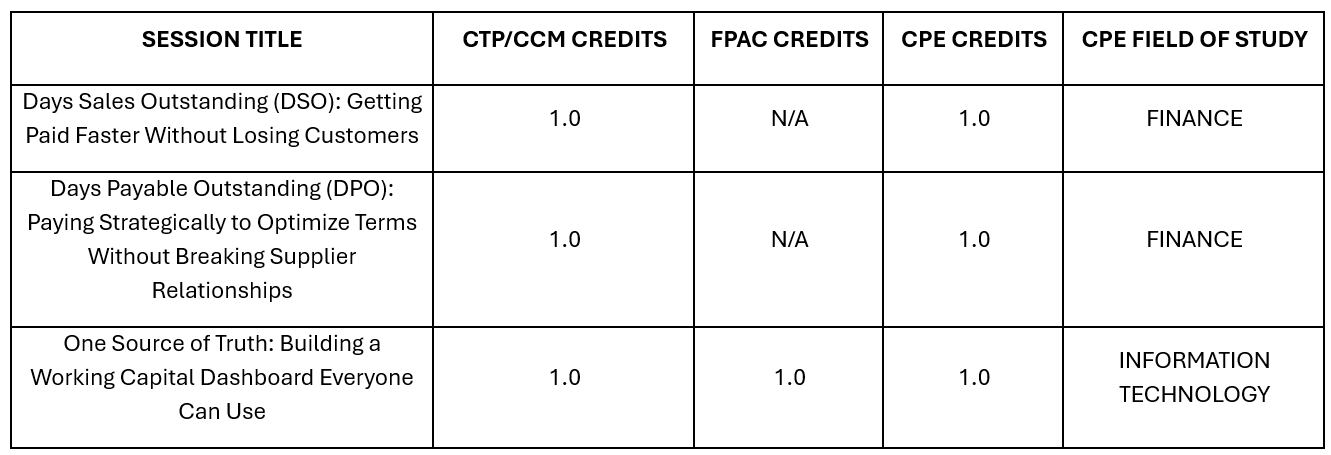
The AFP Treasury Connect helps you maintain your professional credentials. This event qualifies for 3.0 CTP/CCM, 1.0 FPAC, and 3.0 CPE credits. To obtain the maximum credits:
- CTP/CCM: Attend all live sessions.
- FPAC: Attend approved sessions, One Source of Truth: Building a Working Capital Dashboard Everyone Can Use
- CPE: Attend all live sessions and submit the CPE code for each
CTP/CCM and FPAC Recertification Credits
At the conclusion of each session, complete the Session Evaluation. You will receive an email confirming of your attendance for your records, along with instructions for self-reporting your credits in the Recertification Resource Center.
CPE Credits
To earn the approved 3.0 credits, CPAs must:
- Attend each session in its entirety
- Complete the session evaluation
- Enter the unique CPE code for each session in the corresponding evaluation
Note: Partial credit will not be awarded. All requirements must be met for credit to be issued.
Credit Breakdown by Session
 | The Association for Financial Professionals is registered with the National Association of State Boards of Accountancy (NASBA) as a sponsor of continuing professional education on the National Registry of CPE Sponsors. State boards of accountancy have final authority on the acceptance of individual courses for CPE credit. Complaints regarding registered sponsors may be addressed to the National Registry of CPE Sponsors, 150 Fourth Avenue North, Suite 700, Nashville, TN, 37219- 2417. For more information regarding administrative policies such as complaints and refunds, please contact AFP Customer Service, AFP Customer Service, 12345 Parklawn Drive, Suite 200, PMB 1001 Rockville, MD 20852, 301.907.2862, [email protected]. Website: www.nasba.org |
Session Descriptions
Days Sales Outstanding (DSO): Getting Paid Faster Without Losing Customers
Getting paid faster is imperative to maintaining liquidity. This session explores practical, treasury-relevant levers to improve Days Sales Outstanding (DSO), the average number of days it takes a company to collect payment and strengthen liquidity by reducing bottlenecks in the order-to-cash cycle, emphasizing approaches such as payment optimization and AR automation. Speakers will also highlight how DSO impacts working capital accessibility and resilience, especially in uncertain conditions when steady cash flow matters more than ever.
Learning Objectives:
- Identify what a rising DSO signals about cash flow and operational friction and address best ways to identify and benchmark.
- Apply strategies to improve payment optimization, AR automation, smarter credit/collections strategies, and faster cash applications.
Speakers:
Laurie Ann Fleet
Finance Transformation, PwC Partner
Monica Mitchem
Director, Billing Operations, HomeServe
Brian Kehn
VP Operations, HomeServe
Days Payable Outstanding (DPO): Paying Strategically to Optimize Terms Without Breaking Supplier Relationships
Balancing internal liquidity goals with the health of vendors and operational continuity is a challenge for organizations. This session focuses on how organizations think about Days Payable Outstanding (DPO) in the context of working capital optimization—balancing internal liquidity goals with vendor health and operational continuity. We’ll connect DPO decisions to the broader objective of optimizing the cash conversion cycle (DSO, DIO, DPO) and the practical realities of extending terms and coordinating across treasury, procurement, and supply chain.
Learning Objectives:
- Understand how DPO fits into the cash conversion cycle and how best to benchmark.
- Connect working capital performance to cross-functional operating models and collaboration.
Speakers:
Josh May
Global Finance Director, Working Capital & Cash, Solenis
Michael Quails
Managing Director, Deloitte
One Source of Truth: Building a Working Capital Dashboard Everyone Can Use
An effective working capital dashboard creates a shared, consistent view of liquidity drivers—bringing treasury, finance, and operating partners onto the same page. This session focuses on how to design a dashboard that tracks the right working capital metrics, highlights leading and lagging indicators, and supports faster, better‑aligned decision‑making across the organization. Attendees will explore how accessible, well‑governed dashboards move working capital conversations from periodic reporting to continuous management.
Learning Objectives:
- Implement a practical framework for structuring a working capital dashboard around core metrics so stakeholders see balances, drivers and trends.
- Apply the key principles for designing actionable and adoptable dashboards that optimize visibility across treasury, FP&A, and operations to support ongoing tracking and accountability.
Speaker:
Dave Owen
Senior Managing Director, Ankura
Kerri Howard
Treasurer, Aramark