

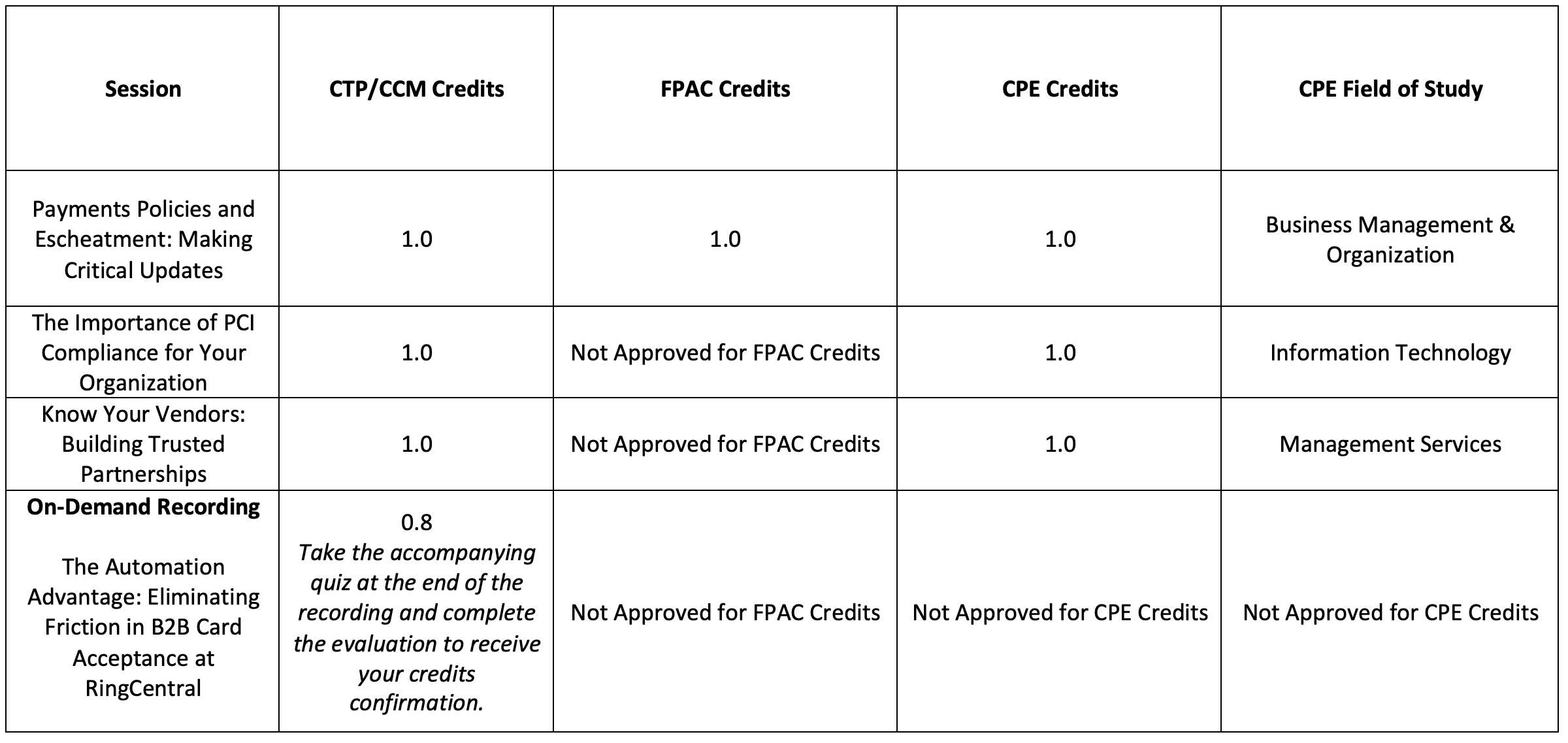
The AFP Enterprise Payments Virtual Series helps you maintain your professional credentials. This event qualifies for a maximum of 3.8 CTP/CCM, 1.0 FPAC and 3.0 CPE credits.
CTP/CCM and CPE: Attend all sessions to claim the maximum credits.
FPAC: Attend the session, Payments Policies and Escheatment: Making Critical Updates, to receive 1.0 FPAC credits.
On-Demand Recording (See Details Below)
To earn CTP/CCM credits for the on-demand recording The Automation Advantage: Eliminating Friction in B2B Card Acceptance at RingCentral take the accompanying quiz at the end of the recording and complete the evaluation to receive your credits confirmation
CTP/CCM/FPAC Recertification Credits
Please self-report your credits in the Recertification Resource Center at www.financialprofessionals.org/recert. You will receive a confirmation of your attendance for your records after completing the Session Evaluation for each session attended.
CPA Continuing Professional Education (CPE) Credits
To request a confirmation of CPE credits earned, complete the Session Evaluation for each session attended. Enter the CPE Code provided at the end of the session in the required field.
 | The Association for Financial Professionals is registered with the National Association of State Boards of Accountancy (NASBA) as a sponsor of continuing professional education on the National Registry of CPE Sponsors. State boards of accountancy
have final authority on the acceptance of individual courses for CPE credit. Complaints regarding registered sponsors may be addressed to the National Registry of CPE Sponsors, 150 Fourth Avenue North, Suite 700, Nashville, TN, 37219-
2417. For more information regarding administrative policies such as complaints and refunds, please contact AFP Customer Service, AFP Customer Service, 12345 Parklawn Drive, Suite 200, PMB 1001 Rockville, MD 20852, 301.907.2862,
[email protected]. Website: www.nasba.org |
Session Descriptions
Payments Policies and Escheatment: Making Critical Updates
Managing payments policies and complying with unclaimed property requirements has become increasingly challenging as regulations evolve and transaction volumes grow. Outdated policies or inconsistent processes can expose organizations to financial risk, audit issues, and customer impact. This session covers best practices for addressing uncashed checks and other unclaimed property, steps for completing due diligence and reporting, and effective ways to work with state agencies.
Learning Objectives:
- Identify the key factors required for updating a payments policy.
- Follow an established process to research, document, and resolve uncashed checks.
- Coordinate with state agencies to report and remit unclaimed property.
Speaker:
Barbara Carpenter
Order to Cash Management
Independent
The Importance of PCI Compliance for Your Organization
Any organization that accepts cards must prioritize PCI compliance. With payments fraud running rampant, order to cash and accounts receivable teams must ensure that they are following the appropriate security standards when storing and transmitting card information. In this session, we provide tips on how to ensure your organization is following the right protocols for card payments.
Learning Objectives:
- Apply PCI Security Standards to properly collect, store, transmit, and protect customer payment data.
- Conduct an annual PCI compliance assessment, including documenting controls, identifying gaps, and implementing required remediation.
- Recognize and mitigate leading fraud threats, such as account takeover, card-not-present attacks, and social engineering schemes.
Speaker:
George Uko
Senior Territory Credit Manager
Kubota Tractor Corporation
Know Your Vendors: Building Trusted Partnerships
Vendors are essential partners in your organization’s success, but trust must be developed. This session walks you through a structured, vendor onboarding process that helps you verify legitimacy, assess compliance, and establish clear expectations. You’ll also learn the key activities to perform annually, such as monitoring performance, reviewing documentation, and assessing risk, to ensure that your vendors continue to earn and maintain your trust for the long term.
Learning Objectives:
- Implement best-practice steps for onboarding vendors, including verification, documentation, and risk assessment procedures.
- Identify and evaluate common vendor red flags, such as inconsistent information, compliance gaps, or unusual transaction patterns.
- Apply a structured set of questions during annual vendor reviews to assess performance, compliance, financial health, and ongoing risk.
Speaker:
Rich Shively
Credit Manager
Williams Distributing/Daikin Comfort
The Automation Advantage: Eliminating Friction in B2B Card Acceptance at RingCentral
Companies that fail to accept virtual cards for B2B payments risk delayed payments, strained customer relationships, and cash flow disruptions. RingCentral experienced some of these challenges with manual processes that consumed time and required ongoing attention to ensure secure handling of sensitive data in compliance with PCI standards.
By implementing Straight-through Processing (STP) without heavy requirements, they eliminated manual touchpoints, secured encrypted card data, and automated remittance posting. The results: over 400 hours saved in six months, improved security, lower card acceptance costs, and a collections team refocused on strategic priorities.
This session highlights the challenges and lessons learned in transitioning to virtual card acceptance and offers strategies to streamline payments and enable finance teams to focus on strategic priorities.
Learning Objectives:
- Identify key drivers of virtual card adoption in B2B payments to improve payment speed and enhance customer experience.
- Implement STP-enabled automation to ensure secure, efficient, and scalable card acceptance.
Speakers:
Rebecca Schultz
Chief Marketing Officer
Boost Payment Solutions
Gina Quinonez
Finance Operations Director
RingCentral