


Articles
Liquidity in Flux: Prioritizing Safety in Uncertainty
- By AFP Staff
- Published: 9/8/2025

How are companies responding to today’s uncertainties? According to the 2025 AFP Liquidity Survey, underwritten by Invesco, organizations managing short-term investments are keeping safety a top priority.
The results also highlighted a continued preference for traditional cash management vehicles, with interest-bearing deposit accounts (and time deposits) leading the pack, followed by government money market funds and treasury securities.
In a companion webinar to the 2025 AFP Liquidity Survey, a panel of experts discussed the implications of the survey findings for treasury professionals.
Tariffs add new uncertainty to cash flow
Tariffs and trade policy are new territory for many practitioners. Laurie Brignac, Chief Investment Officer for Invesco, underscored just how unusual this development is. “This is the first time in my entire career [30+ years] that we’ve even talked about tariffs,” she said.
Marcel Santiz, Treasury Director for Masco Corporation, noted that his company expects tariffs to reduce cash flow through higher costs and weaker consumer demand. “The overall cash impact is, we would expect to be down because we're paying tariffs that we were not paying before,” said Santiz. While they plan to maintain year-end cash targets, tariffs and their impacts may reduce foot traffic at retail, which could result in headwinds.
The challenge, Brignac explained, is the lack of transparency: Companies don’t yet have the details they need to model impacts across industries and geographies. “Until you actually have pen to paper with all the different countries, it’s really hard to plan,” she said. “So, it’s just holding a little more cash until we can really identify what it means for our particular company.”
Corporates stick to “plain vanilla” investments
When asked how corporates would react to a sharp rate cut, Santiz answered by sharing his company’s conservative stance. He said their strategy would be to first ride out yields in money funds, then consider diversification, but overall remain anchored in safe, simple instruments, such as time deposits.
“Our board’s conservative and very concerned with safety,” said Santiz. “It’s hard to go out and make a justification that we should go 14 days out the curve for two basis points.”
Their approach reflects a broader trend: Many corporates have avoided instruments like commercial paper since the Great Recession and now stick primarily to overnight availability. The mentality, as Hunt put it, is: “Don’t explain something to the board that you don’t have to.” As a general rule, boards are wary of risk, preferring to leave yield on the table rather than justify complexity for minimal returns.
Money market funds hit record highs
Money market funds are enjoying historic levels. Assets recently reached $7.4 trillion, and panelist Peter Crane, President and Publisher, Crane Data, predicted they could climb to $8 trillion by year-end. The combination of safety and favorable yields has drawn both retail and institutional investors, especially as bank deposits plateau.
“Nobody really has to fight for yield right now,” said Crane. “All of a sudden, you’ve got 5%, now 4%, and everybody’s happy with those levels.”
Government and treasury funds alone are offering levels not seen in years. Even if rates decline, the lag in money fund repricing means they will remain competitive, retaining their status as a central tool in corporate liquidity management.
Market supply shapes liquidity options
With the debt ceiling lifted, U.S. Treasury bill issuance is ramping back up, providing ample supply for money market funds. This alleviates concerns about a shortage of safe, short-term instruments.
“There can be disruptions around the debt ceiling, but there is plenty of supply right now for this to accommodate the money fund growth,” said Brignac.
Commercial paper, meanwhile, remains constrained. While prime funds are starting to show more demand for CP, many corporates are effectively shut out due to strict ratings requirements. For example, Santiz noted his company hasn’t purchased commercial paper since 2008–09, in part because much of the market is now rated below its policy thresholds.
“We weren’t getting term advantage, and we’re not allowed to buy A2/P2,” he said. “That was really what moved us off of commercial paper.”
Tokenization and stablecoins are the future — not the present
While there is plenty of growing interest in stablecoins, tokenized funds as collateral tools and EFTs, the panel agreed they are early-stage experiments.
“There's a lot of smoke,” said Crane. “There's probably a little fire at this point, but there's so much smoke in there.”
Santiz explained that he would be reluctant to pursue such investments due to counterparty and liquidity risks, especially given past experiences with alternative assets. “Looking at something like stablecoins, my feeling is that the counterparty risk and the lack of history with respect to liquidity would be concerns that would keep the board from being interested,” he said.
Brignac added that tokenized funds are currently structured as share classes of government money funds, making them stable-value products, but adoption will depend on building trust and demonstrating clear use cases.
“Stay tuned,” said Crane. “There are a lot of developments there.”
Interested in learning more? AFP Members have complimentary access to the full 2025 AFP Liquidity Survey Report, underwritten by Invesco. Non-members can receive access to the key highlights.
![UMB Bank Vert Full Color CMYK[2]](/images/default-source/article-images/interpayments-logo_png.png?sfvrsn=4213fb6b_1 "Interpayments Logo")
Copyright © 2026 Association for Financial Professionals, Inc.
All rights reserved.
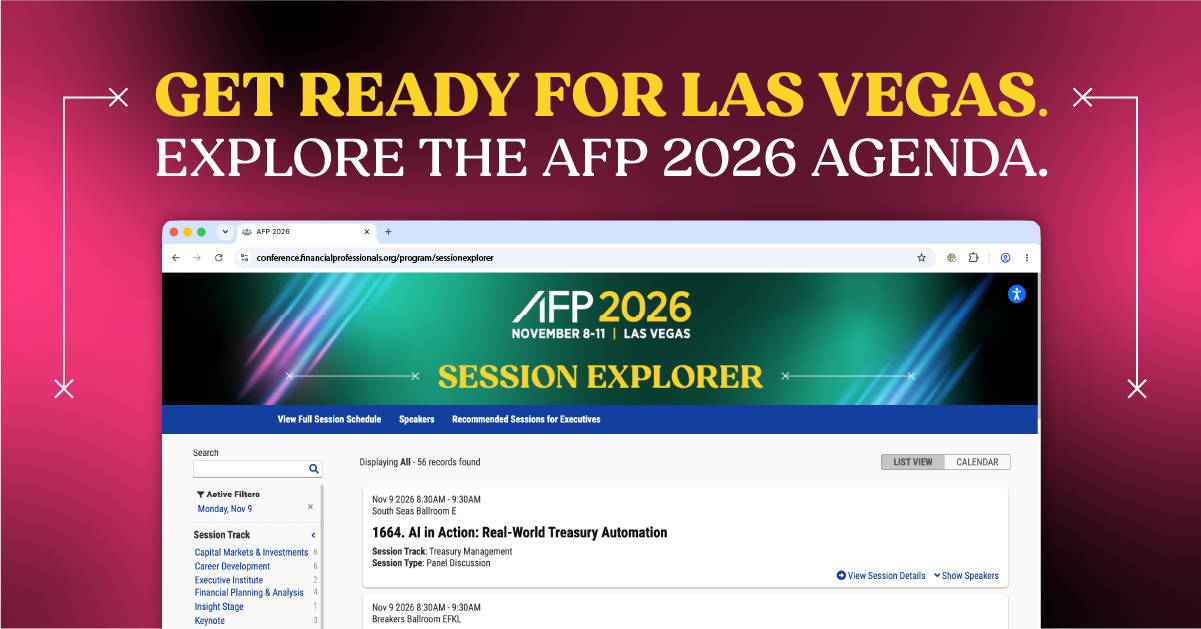
🔍 Browse 140+ sessions by day or track
💡 Discover the speakers sharing
real-world treasury and finance strategies
🤝 Find networking experiences designed
to help you connect with peers
📅 Build your plan before you arrive
Start Exploring
AFP Membership
The Hub for Treasury and Finance Professionals
As an AFP member, you'll gain access to exclusive training, certifications, research and networking to advance your career.
AFP Newsletters
Unbiased, practitioner-driven information for treasury and finance professionals
Subscribe to an AFP Newsletter to receive the latest news, events and trends in FP&A, Treasury or career planning.