

Articles
Do You Need to Update Your Payments Strategy?
- By AFP Staff
- Published: 6/24/2026

It is best practice to review all company finance and treasury strategies regularly to take account of the impact of new technologies and processes and to ensure compliance with relevant rules and regulations. In the case of payments, the ongoing fight against fraud provides another motivation to review strategy more often.
For those not yet fully compliant, the introduction of new Nacha Rules in 2026 represents another reason for treasury practitioners to review their payment strategies. In summary, Nacha has introduced a new fraud monitoring rule to combat the increased threat of credit-push fraud, which is rising through the growth in business email compromise (BEC) and other social engineering scams. The rule requires originators to implement or update processes and procedures that “are risk-based and reasonably intended to identify fraudulent transactions.” Given the constantly changing threat of fraud, originators will be expected to review their fraud monitoring processes and procedures at least annually.
Other than maximizing protection against payments fraud, there are other reasons to review the payments strategy. Investment in new digital payment rails has widened the choice of payments for all organizations, while providing improved access to payment data and real-time transaction initiation opportunities. Perennial issues, such as unclaimed property concerns, remain, although new tools are being developed to address these, too.
Whatever the motivation, a payments strategy review should do the following:
- Review existing practices. A good way to understand current processes is to map them out step by step. Doing so will help identify any inefficiencies, such as data rekeying or significant exceptions, and the impact of using Same-Day ACH and instant payments on payment controls. The review should also assess the quality of the flow of information between the organization and the bank, and the organization’s ability to process that data.
- Update processes and procedures, where necessary. The ideal solution is one that is standardized. Automated processes are more scalable and controllable than manual equivalents and are generally more cost-effective due to lower operational costs.
- Improve communication, where possible. As well as API and other connectors between the bank and the organization, consider how data flows within the organization (e.g., between business units, accounts payable and treasury).
- Consider the wider impact on treasury and finance. Changes to payments processes will impact company cash flow and working capital, so adjustments to forecasting and liquidity management processes may be necessary.
- Continue to focus on fraud. Standardization and automation are important protections against the risk of fraud. The adoption of anti-fraud tools, such as account verification, will help to reduce the risk. Having a clear policy on the collection and storage of customer, vendor and employee payment information is another vital element of protection against fraud. The best protection is a layered approach, with controls applied at multiple points in the process.
- Determine which payment types to implement. With more choice than ever, practitioners need to determine whether to set up certain payments (e.g., instant payments). Variables include urgency, reachability and cost, as well as wider working capital and other business benefits.
- Develop rules to define which payment type should be used in different circumstances. Each company should set payment routing parameters based on its preferences regarding payment instruments and rail selection. Where those parameters are clearly defined, payment routing can be automated.
- Have robust processes covering payment initiation and approval. Payee identity and settlement instructions should be validated before payment is initiated. The payment workflow should embed key controls, including segregation of duties, so that payments are approved by someone other than the initiator.
- Continue to monitor new payment options. The continuous evolution of the payments landscape creates both risks and opportunities for treasury practitioners. The strategy should address how to evaluate emerging payment rails and digital currencies, such as stablecoins. The chosen approach will depend on factors such as the organization’s risk tolerance and the expectations of its customer base.
The AFP Payments Guide: Revisiting Your Payments Strategy, underwritten by PNC Bank, addresses these core points in more detail. The guide includes key tips and is supported by case studies that show how treasury practitioners protect their organizations against the risk of fraud. Fill out the form below to download the guide.
Copyright © 2026 Association for Financial Professionals, Inc.
All rights reserved.
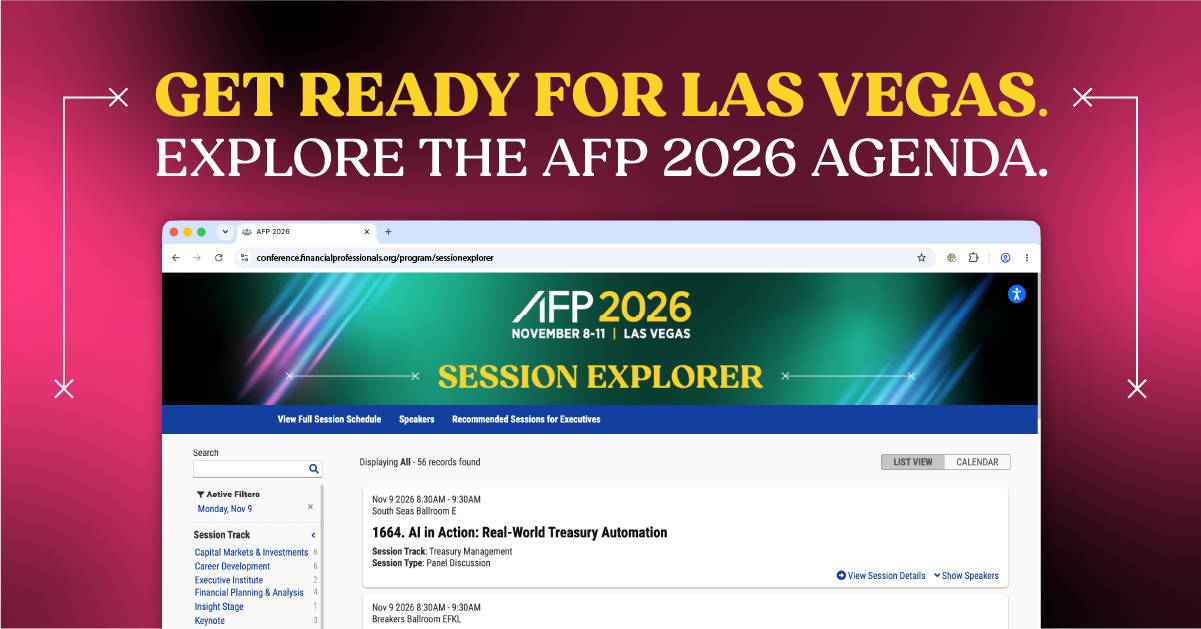
🔍 Browse 140+ sessions by day or track
💡 Discover the speakers sharing
real-world treasury and finance strategies
🤝 Find networking experiences designed
to help you connect with peers
📅 Build your plan before you arrive
Start Exploring
AFP Membership
The Hub for Treasury and Finance Professionals
As an AFP member, you'll gain access to exclusive training, certifications, research and networking to advance your career.
AFP Newsletters
Unbiased, practitioner-driven information for treasury and finance professionals
Subscribe to an AFP Newsletter to receive the latest news, events and trends in FP&A, Treasury or career planning.