


Articles
Corporate Budgeting Is Becoming Continuous, Connected and More Strategic
- By AFP Staff
- Published: 10/6/2026

If we were to flip the calendar back to 2019, we would see a much different budgeting process than we find today. Before organizations had to navigate a pandemic, inflation, supply chain disruption and interest rate volatility, the annual budget was one of finance’s primary organizing tools. It served to establish assumptions, set targets, allocate resources and measure actual performance against the plan.
The budget hasn’t disappeared in the past century. As management pioneer James O. McKinsey wrote in 1922, budgets help organizations establish assumptions, allocate resources and measure performance. What's changed is how organizations use the budgeting process itself.
Rather than simply establishing a financial plan for the fiscal year, budgeting has evolved into a complete integrated planning process that needs to help organizations adjust when conditions change.
Comments from the Association for Financial Professionals’ FP&A Advisory Council suggest that the budgeting process is moving toward more continuous planning, greater involvement from the business and increased use of technology.
Even so, the 2026 AFP FP&A Benchmarking Survey shows organizations are progressing at different rates. The average time required to create a budget is essentially unchanged at 8.7 weeks in 2025 compared with 8.5 weeks in 2022. Meanwhile, just 57% of respondents said their organizations are able to create an out-of-cycle forecast, only modestly higher than the 54% reported in 2022.
What this tells us is that while budgeting and forecasting remain essential to how organizations plan and allocate resources, the process is still labor-intensive.
Key takeaways
- The budget process is becoming a business-wide responsibility. FP&A's role is evolving from consolidating numbers to facilitating decisions across strategy, operations and finance.
- Technology and AI can accelerate mechanical work and improve data quality, but they cannot create the cross-functional ownership and shared assumptions that define mature planning organizations.
- The organizations furthest along in the evolution of budgeting are combining continuous planning, operational leadership involvement and automation, transforming the annual budget into a strategic decision-making framework.
AFP FP&A Guide to a Better Budgeting Process
 Get proven budgeting best practices from finance leaders to cut cycle times and drive cross-functional alignment.
Budgeting trend: Scenario planning moves beyond the annual budget
One clear change is a move away from treating the annual budget as a fixed plan. “Since Covid, our budget process has become more flexible and data-driven,” said one FP&A Advisory Council member. They now rely more on rolling forecasts, key business drivers and regular variance analysis to respond to changing traffic, revenue, costs and market conditions.
Another finance leader, Julian Scutari, described planning as becoming “more dynamic and less annual/static,” with an increased use of rolling forecasts, scenario planning, driver-based assumptions and faster cross-functional input. These practices allow organizations to continually reassess their assumptions rather than waiting for the next annual planning cycle.
Scenario planning is particularly important in this market environment. AFP’s benchmarking research found that organizations using structured scenario planning demonstrate superior planning maturity across every area evaluated. They were more likely than non-structured scenario planners to use rolling forecasts (57% vs. 33%) and to track forecast accuracy. They also completed budgets 11% faster, averaging 8.1 weeks compared with 9.2 weeks.
And the benefits extend beyond speed. Organizations using structured scenario planning also reported stronger strategic alignment, integration of external factors and horizontal alignment across operations.
Practitioners are increasingly putting those principles into practice by stress testing financial plans against potential disruptions. Tyler Vonderheide, Senior Manager FP&A Systems and Product Enablement at Southwest Airlines, said his process incorporates “upside and downside scenario planning and a fair cash balance.”
Rosemary Linden, President of Momentum CFO, described a more structured approach: “We begin by identifying the financial and operational risks that could have the greatest impact, then build base, upside and downside scenarios to model the potential outcomes. For each scenario, we establish early warning indicators that conditions may be deteriorating and define specific management actions, so leaders know when and how to respond.” The goal, she said, is not simply to quantify risk, but to improve preparedness and enable faster, better-informed decisions.
Still, structured scenario planning is the exception rather than the rule. Just 38% of respondents currently use it, and only 43% of organizations use rolling forecasts, leaving the door open for the rest to move from periodic budget updates to continuously managing the assumptions, risks and opportunities behind it.
Budgeting trend: FP&A shifts from budget owner to planning facilitator
Budgeting is moving beyond finance. “The biggest shift since Covid is that budgeting is no longer primarily an accounting exercise,” said Haresh Vayal, CFO at American Councils for International Education. “It has become a strategic risk management and resource allocation process.”
For Vayal, that means bringing budgeting, forecasting, grants management, workforce planning, cash-flow analysis and predictive analytics together into a decision-making framework. Success, he said, is increasingly determined not by how accurately an organization budgets once a year, but by how quickly it can adapt.
Other Advisory Council members described a corresponding change in who participates in the process. Jeff Zielinski, CFO at Buy&Ship, said his organization has adopted “a much more cross-functional approach to budgeting” since Covid. Another practitioner described transitioning from a finance-led process to an operations-focused one and using an EPM platform to push planning down to individual operational owners and prioritize business drivers and assumptions rather than just line items.
The movement toward shared ownership hits upon one of the more significant weaknesses AFP’s benchmarking research identified. Organizations report relatively strong alignment of planning with strategic goals: 63% rate their performance in that area as effective or very effective, while 62% say the same about communication with leadership. But the further into the organization you go, the less effective it is. Only 53% report effective collaboration among business operations, 47% report consistent assumptions and variables, and 46% report effective horizontal alignment across business operations.
There’s a similar disconnect in how organizations perceive the budget itself: 88% percent of CFOs and 85% of financial professionals consider the budget useful, compared with only 62% of business units.
For FP&A, closing that gap will require more than simple input from business units during budget season. It requires operational leaders to be part of the planning process and ground financial assumptions in the drivers they manage. This changes finance’s role. Rather than collecting numbers, challenging submissions and consolidating a budget, FP&A increasingly acts as a facilitator connecting strategy, operations and financial outcomes.
The change is in fact already occurring. The benchmarking survey found respondents spend 21% of their time on activities beyond traditional finance, including strategy, technology implementation, human resources and operations.
Budgeting trend: Technology is accelerating the budgeting process at leading organizations
Technology is helping support this new era of budgeting in many ways. FP&A Advisory Council members cited EPM systems, Anaplan, Power BI, SAP reporting and automated Excel models as ways to consolidate data, automate workflows, improve reporting and provide decision-makers with faster access to the information they need.
AI is, of course, entering the process as well, though the use cases practitioners described remain targeted. At Buy&Ship, Zielinski said the company has incorporated an AI model as a check during budget development, which has helped identify potential inconsistencies involving users and orders, seasonality and margins before the budget is finalized.
Linden said AI now handles some of the time-intensive mechanical work involved in preparing budgets, including cleaning and structuring historical data, generating baseline projections and drafting initial variance narratives and board summaries. “This allows me to spend less time on mechanics and more time applying judgment, evaluating scenarios and supporting better business decisions,” she said.
Other respondents report using AI for testing inflation, interest-rate and foreign-exchange assumptions; identifying anomalies; analyzing trends; drafting commentary; summarizing inputs; and pressure-testing assumptions. What’s notable about those applications is what AI is not doing. Practitioners are using it to accelerate analysis and reduce manual work rather than asking it to make financial judgments.
Technology can make a planning process faster, more connected and easier to update; it cannot create shared assumptions, cross-functional ownership or a culture willing to reconsider the plan when things invariably change.
The evolution of corporate budgeting
The organizations furthest along in the budgeting evolution are combining all three trends. They're treating planning as an ongoing process rather than an annual event. They’re bringing operational leaders into planning rather than leaving nearly the entire process with finance. And they’re using automation and AI to reduce the mechanics of budgeting, allowing FP&A to devote more time to scenario planning, judgment and decision support. Rather than treating the budget as a set of numbers the organization commits to once a year, leading organizations are using it to guide decisions throughout the year.
Copyright © 2026 Association for Financial Professionals, Inc.
All rights reserved.
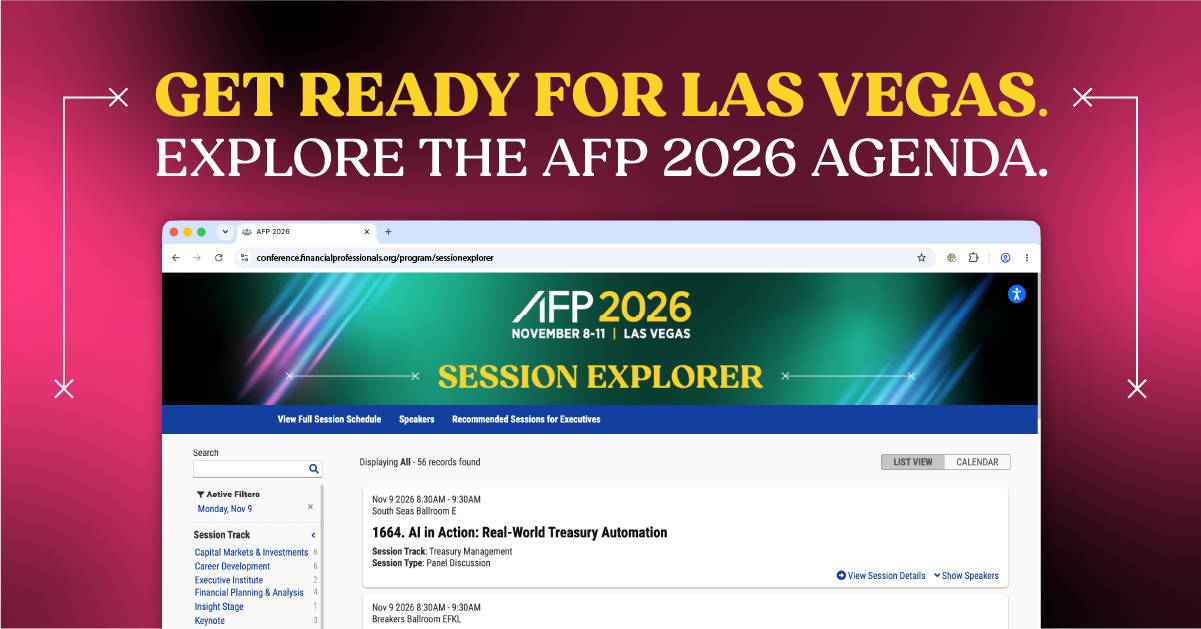
🔍 Browse 140+ sessions by day or track
💡 Discover the speakers sharing
real-world treasury and finance strategies
🤝 Find networking experiences designed
to help you connect with peers
📅 Build your plan before you arrive
Start Exploring
AFP Membership
The Hub for Treasury and Finance Professionals
As an AFP member, you'll gain access to exclusive training, certifications, research and networking to advance your career.
AFP Newsletters
Unbiased, practitioner-driven information for treasury and finance professionals
Subscribe to an AFP Newsletter to receive the latest news, events and trends in FP&A, Treasury or career planning.