


Articles
Building Trust in AI-Driven Revenue Forecasts
- By Gayatri Kannan
- Published: 5/4/2026

Traditional financial forecasting has always depended on one core principle: trust. Leaders commit headcount, investment and guidance based not only on the numbers themselves but also the assumptions, controls and processes behind them. Traditionally, in the software as a service (SaaS) world, trust was easier to earn because the business was anchored in contracts with predictable, structured renewal cycles, allowing top-down models to provide sufficient accuracy for planning revenue, margin and cash flow.
Consumption-based pricing turns that foundation on its end. Consumption-based customers can scale usage up or down at will. This means revenue is no longer tied to contracts; it is attached to customer behavior, making it elastic. Volatility moves from the margins to the core of the business.
In response, finance teams are turning to artificial intelligence (AI) and machine learning (ML) to forecast at the individual customer level and better understand how individual customers ramp, expand, contract and respond to incentives. These models promise greater precision and earlier signals, but precision is not the same as reliability. This introduces a new challenge: governance.
When forecasts are generated across thousands of accounts, each with varying levels of accuracy, the question becomes, “Is this forecast reliable enough to guide decisions and communicate with investors?”
How AI models customer behavior (and the risk that creates)
AI-driven forecasting models analyze historical consumption patterns across customer cohorts grouped by industry, geography, company size, tenure and maturity. A new customer may ramp unpredictably. A long-tenured enterprise customer may follow more stable patterns. ML models learn from these trajectories and generate forward-looking predictions at the account level.
Individually, these predictions are imperfect. Some accounts will be overforecasted while others will be underforecasted. When aggregated across a large portfolio, however, the variance normalizes, yielding a more stable overall forecast. AI extends this capability through exception-based monitoring, which flags high-risk or high-impact customers, identifies unusual consumption patterns and detects deviations from expected ramp behavior. These models can also incorporate seasonality, product launches and incentive-driven behavior shifts.
The result is a more responsive forecasting system that surfaces signals earlier and reduces reliance on manual spreadsheet review. But accuracy alone is not enough. Validation is the real challenge.
Governance: The missing layer in AI forecasting
To build trust in AI-driven forecasts, finance teams are developing governance frameworks that make model outputs explainable, testable and auditable. AI and ML models can identify patterns at scale, but they rely on historical data and can produce outputs that do not reflect rapidly changing business conditions. Because customer behavior can shift within a single quarter, it’s crucial to continuously validate forecasts against the current context when operating in consumption-based environments.
As these projections guide investments, capital allocation and sales strategy, there is little room for error. Governance frameworks create decision rights, controls, oversight and accountability mechanisms to ensure that model outputs are tested, contextualized and refined before they influence critical decisions.
Several practices are emerging as essential:
- Aggregate-first validation. Rather than judging model accuracy at the individual account level, where variability is high, finance teams evaluate performance at the portfolio level. AI-driven forecasts may be within 5% of actuals in aggregate, while the variance at the individual customer level can be as high as 25%. At scale, these deviations offset each other, producing a more reliable overall view.
- Pipeline triangulation. Near-term forecasts are cross-checked against the sales pipeline, which is often the most reliable indicator of short-term performance because sales teams actively manage it. AI and ML can project pipeline conversions, creating a reality-based check on model outputs.
- Large-customer overlays. Typically, a small number of customers drives the bulk of an organization’s revenue. Finance teams manually review these accounts, adjusting projections where necessary to avoid distortion. These adjustments are then fed back into the model.
- Continuous feedback loops. Forecasts are regularly compared with actual outcomes. Patterns of overforecasting or underforecasting trigger recalibration of model parameters. Cross-functional input from sales and product teams provides additional context.
Together, these controls transform AI from a “black box” into a governed system that finance leaders can stand behind with confidence.
A practical example: When governance changes the forecast
Consider a portfolio of 1,000 customers, for which an AI model projects 15% revenue growth based on past expansion patterns. On first glance, the forecast appears strong. Governance controls, however, reveal two critical issues.
Late-stage deal conversion is slower than expected, and approximately 20% of high-revenue accounts are approaching saturation, limiting immediate growth potential. After adding insights from large customers and reconciling assumptions, projections are revised to 10% growth.
This more cautious assessment will likely translate into more reasonable planning. Leadership and stakeholders will have a more realistic basis for planning and expectation setting. Most importantly, the organization and its people will be on the same page about what can realistically be accomplished in the near term. AI identified the opportunity, and governance made the decision.
Key performance indicators for forecast accuracy and governance
To ensure AI-driven forecasts are reliable, finance teams can track several key performance indicators (KPIs). These metrics serve as governance tools and provide a structured system for evaluating consumption-based businesses:
- Forecast accuracy by segment or region. Evaluating forecast performance across locations, industries or customer groups highlights where models overperform or underperform. This metric helps identify biases or missed signals and facilitates model refinement.
- Bookings-to-revenue ratio. Calculated as next year’s booked commitment divided by prior-year consumption, this ratio provides a forward-looking view of growth. For example, $120 in bookings against $100 in prior-year revenue yields a 1.2 ratio, signaling forward expansion. It also serves as a triangulation tool, enabling finance teams to compare model outputs against observed customer behavior and pipeline activity.
- Percentage of contract consumed. This KPI measures actual usage relative to time elapsed in a contract. Overconsumption may signal near-term upside but can also create capacity exhaustion risk. Underconsumption may indicate customer dissatisfaction or a reduction in future bookings.
- Forecast concentration in top customers. Because a small number of accounts can disproportionately influence revenue, these customers are often evaluated separately. To verify forecasts and reflect current deal dynamics and customer behavior, consult with sales and deal desk teams to ensure the model reflects real-world customer behavior.
- Multi-year deal mix. A higher proportion of multi-year commitments improves forecast accuracy by establishing a baseline for contracted demand. In these cases, models predict consumption relative to committed volume, thereby reducing uncertainty tied to booking patterns.
Monitoring these metrics helps finance teams validate AI outputs, detect bias and confirm that forecasts align with customer behavior and current business conditions.
From prediction to trust
The shift to consumption-based pricing introduces a level of uncertainty that traditional forecasting methods are not equipped to handle. With AI, finance teams can model customer dynamics at scale and identify emerging trends sooner. But insight alone is not enough.
Reliability can be achieved by combining customer-level behavior modeling, aggregate validation and disciplined governance practices that ensure outputs are continuously tested against real-world conditions. By integrating AI-driven insight with structured human oversight, finance leaders can navigate consumption models with greater confidence. In the end, the goal isn’t just to make good predictions; it’s to make trustworthy forecasts that can inform critical decisions.
About the Author
Gayatri Kannan is senior director and head of sales finance at a leading global technology company. She leads strategic planning, investments, forecasting and incentives for a global sales organization, driving a multi-billion-dollar business. With over a decade of experience across global investment banking, development finance and high-growth enterprise software, Kannan’s expertise has been central to scaling businesses while creating long-term shareholder value. She earned her master’s degree in business administration from the Kellogg School of Management, Northwestern University, and graduated with honors in Bachelor of Technology from the Indian Institute of Technology. Connect with her on LinkedIn.
Copyright © 2026 Association for Financial Professionals, Inc.
All rights reserved.
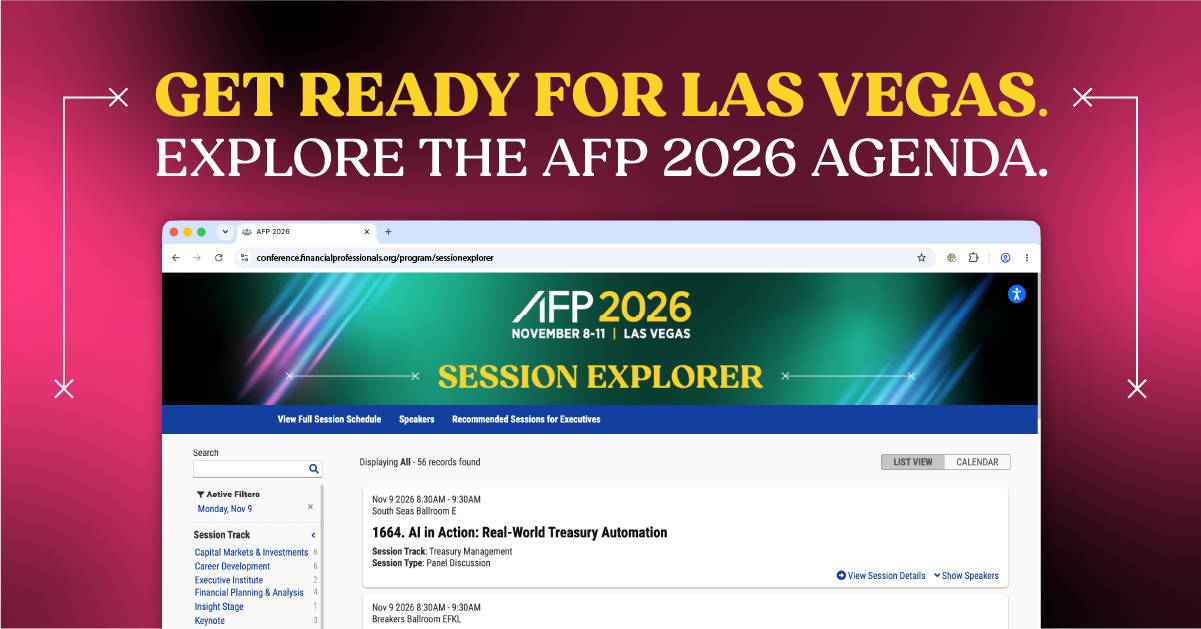
🔍 Browse 140+ sessions by day or track
💡 Discover the speakers sharing
real-world treasury and finance strategies
🤝 Find networking experiences designed
to help you connect with peers
📅 Build your plan before you arrive
Start Exploring
AFP Membership
The Hub for Treasury and Finance Professionals
As an AFP member, you'll gain access to exclusive training, certifications, research and networking to advance your career.
AFP Newsletters
Unbiased, practitioner-driven information for treasury and finance professionals
Subscribe to an AFP Newsletter to receive the latest news, events and trends in FP&A, Treasury or career planning.