


Articles
Beyond the Annual Budget: The Case for Evergreen Planning
- By Narayanan Alaghappan, Controller and Reporting & Analysis Lead for Integrated Gas Businesses, Shell
- Published: 8/12/2026

The Budget as More Than a Control System
Many organizations treat budgets as control systems. Leaders establish targets, measure performance against those targets and spend the year explaining variances. The underlying assumption is that success comes from accurately predicting the future during the budgeting process and then holding managers accountable to that forecast.
But what if the purpose of the budget were different?
What if we recognized that change and deviation are natural features of business rather than exceptions to be explained? What if budgeting evolved from a control mechanism into a guidance system, helping organizations navigate uncertainty while remaining focused on long-term value creation?
This perspective shifts the conversation from prediction to decision-making and from compliance to performance.
The Evergreen Planning Process
An evergreen planning approach begins with strategy and the key drivers of value creation.
Leadership identifies the factors that have the greatest influence on long-term performance and uses these drivers to establish a clear ambition for the business over the next several years. That ambition represents the destination. The budget is one pathway toward it, not the destination itself.
As market conditions evolve, leadership teams can adjust tactics, resources and priorities without losing sight of their long-term objectives.
Traditional budgeting treats the plan as a fixed annual commitment. Evergreen planning treats it as a living representation of the business, continuously updating assumptions as new information becomes available while maintaining alignment around strategic objectives.
In this environment, reforecasting becomes event-driven and situationally aware. Rather than updating plans simply because the calendar dictates it, organizations focus on changes in business conditions, operating performance or external assumptions that warrant a reassessment of direction and priorities.
The emphasis shifts from managing budget variances to managing initiatives. Leaders spend less time explaining why outcomes differ from assumptions made months earlier and more time discussing actions, decisions and interventions that drive future performance.
The Human Dimension of Planning Transformation
The most significant challenge in modernizing planning is rarely technology.
More often, it is changing behaviors and incentives.
People naturally seek certainty. When performance is evaluated primarily against a fixed budget, teams often focus on protecting forecasts, adding contingencies and minimizing downside risk. While understandable, these behaviors can unintentionally reduce agility and discourage value-creating decisions.
Organizations that adopt a more dynamic approach to planning encourage leaders to focus on controllable actions, strategic choices and long-term outcomes. Success is measured less by forecast precision and more by an organization's ability to learn, adapt and move consistently toward its objectives.
This requires transparency, timely data and a culture that views planning as a tool for decision-making rather than prediction. When leaders understand the purpose behind the change, planning can become a powerful mechanism for improving performance rather than simply monitoring it.
The challenge is sustaining these behaviors over time. Without visibility, accountability and trusted information, organizations can easily revert to traditional budgeting habits.
Finance plays a critical role in enabling this transition. Beyond stewardship and governance, finance acts as the connector between strategy, operations and performance, providing the insight, transparency and challenge required to support better decisions.
Rethinking the Planning Cycle
Moving toward an evergreen approach requires changes across several dimensions of the planning process.
1. Strategize & Plan: Strategy, Drivers and Direction
The starting point is a simple question:
What truly drives value in the business?
This question anchors planning in business economics rather than calendar-driven routines.
Organizations identify the critical drivers that influence long-term success and continually update assumptions around those drivers as circumstances evolve. The objective is not to create perfect forecasts but to improve understanding of how changes in assumptions influence future outcomes.
This creates the foundation for a living planning process that evolves with the business.
In this model:
Strategy defines where the organization is going.
Business drivers explain how value will be created.
Budgets become one expression of strategy rather than the strategy itself.
The focus shifts from precision to preparedness.
2. Align & Decide: Connecting Strategy to Execution
Once strategic priorities and value drivers are understood, organizations translate them into decisions about resources, investments and execution.
A key step is establishing a clear long-term ambition for each area of the business. This ambition provides a reference point for evaluating opportunities, allocating resources and making trade-offs.
Rather than creating rigid commitments, it gives teams a shared direction while allowing flexibility in how they respond to changing circumstances.
The result is greater alignment between strategy and day-to-day decision-making, helping organizations remain focused on long-term outcomes even as short-term conditions evolve.
3. Measure & Adjust: Managing Performance Through Action
The most visible change often occurs in performance management.
Instead of focusing on why actual results differ from budget assumptions, leaders focus on what actions are being taken, what decisions are required and whether those actions are improving outcomes.
Organizations also benefit from distinguishing between controllable and uncontrollable factors. Market conditions, regulatory developments and macroeconomic changes often affect performance but fall outside management control. Effective performance management recognizes these realities while maintaining accountability for actions and decisions that leaders can influence.
Planning becomes a continuous cycle of learning, adaptation and improvement.
Each iteration provides an opportunity to refine assumptions, test actions and strengthen future decision-making.
Building the Planning Infrastructure
Evergreen planning depends on more than process redesign. It requires the right information foundation.
Reliable data, connected planning tools and integrated operating models enable organizations to move information efficiently from business drivers into planning outputs and decision processes.
The goal is not simply to forecast more frequently. The goal is to capture information once, connect it across systems and reuse it wherever it creates value.
This can support forecasting, reporting, scenario analysis, investment evaluation and a range of other finance and business processes.
Many organizations continue to face challenges integrating planning and operational data across systems. Realizing the full benefits of evergreen planning often requires significant investment in data architecture, process simplification and tool integration.
The conceptual destination is clear: a planning environment where insights move faster, decisions improve and resources are allocated more effectively.
Looking Forward
The future of planning is unlikely to be defined by increasingly detailed annual budgets.
Instead, it will be characterized by organizations that combine strategic clarity, operational flexibility and real-time insight to navigate uncertainty more effectively.
Budgets will continue to play an important role. However, their value will increasingly come from helping organizations understand options, evaluate trade-offs and align around long-term objectives rather than serving as fixed commitments in an unpredictable world.
Evergreen planning is ultimately not about forecasting more. It is about making better decisions.
And in a world where change is constant, that may be one of the most valuable capabilities an organization can build.
This article is a practitioner’s perspective. It reflects general perspectives on planning and budgeting practices. It does not disclose confidential Shell information, Shell financial performance, Shell targets or Shell’s formal corporate position on AFP’s wider guide.
Interested in learning more? The AFP interactive FP&A guide, A Better Budgeting Process, provides finance and FP&A professionals with strategic insights, best practices and actionable strategies to modernize budgeting and create greater value across the organization.
Copyright © 2026 Association for Financial Professionals, Inc.
All rights reserved.
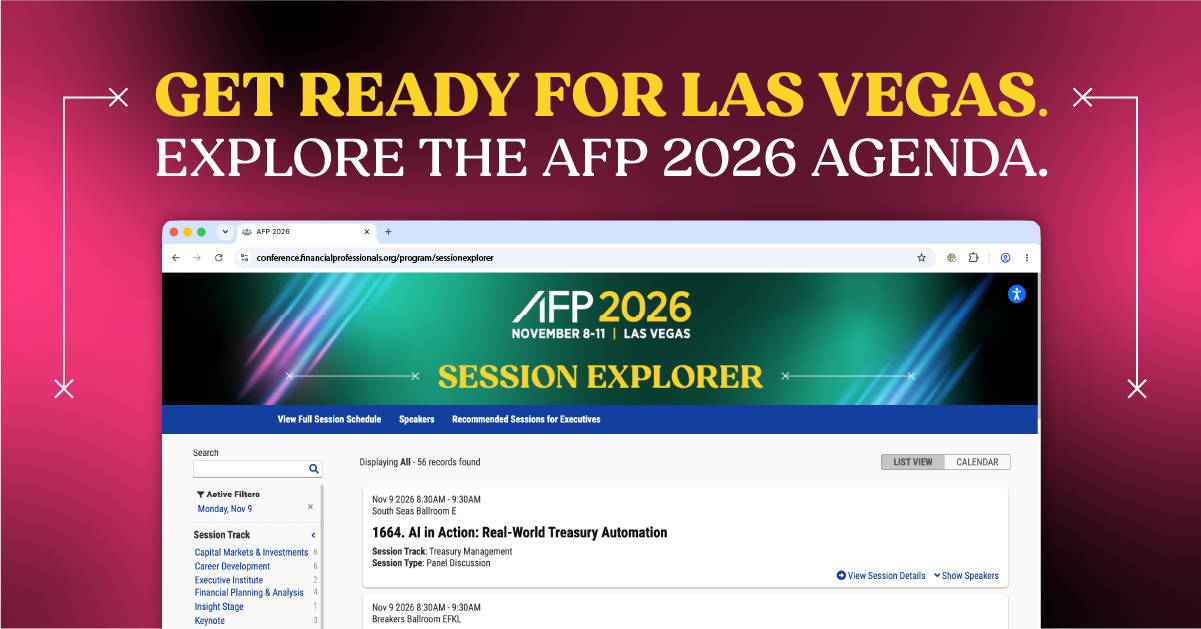
🔍 Browse 140+ sessions by day or track
💡 Discover the speakers sharing
real-world treasury and finance strategies
🤝 Find networking experiences designed
to help you connect with peers
📅 Build your plan before you arrive
Start Exploring
AFP Membership
The Hub for Treasury and Finance Professionals
As an AFP member, you'll gain access to exclusive training, certifications, research and networking to advance your career.
AFP Newsletters
Unbiased, practitioner-driven information for treasury and finance professionals
Subscribe to an AFP Newsletter to receive the latest news, events and trends in FP&A, Treasury or career planning.