


Articles
Between Hype and Harvest: 3 Questions to Save Your AI Project
- By Anshuman Yadav
- Published: 6/9/2026

A financial services firm I worked with spent eight months deploying an AI-powered underwriting tool. The hype: tighter loss predictions, faster decisioning, better pricing. When it ran its first ROI assessment, the results were deeply disappointing. Loss rates were moving in the wrong direction.
The postmortem revealed something that had nothing to do with the AI. The credit team used average historical loss data by portfolio at 1.8%; the risk department added a conservatism buffer for tail scenarios at 2.6%. Finance used its P&L spreadsheet built on IFRS 9 and expected credit loss calculations at 3.4%. Three legitimate but incompatible definitions, all labeled "loss rate" in the data. The AI worked exactly as designed, but the design was flawed, leading to dirty data that met none of the departmental needs.
Gartner now predicts that through 2026, organizations will abandon 60% of AI projects, with poor data quality as the primary cause. Failure rarely gets announced. Organizations cancel the project, blame the tool and restart with a different platform. But the foundation problem travels with them.
AI in Finance Certificate
The No Code AI for Finance Certificate program is built for finance professionals who want real, usable AI skills today. Learn to implement AI responsibly, transparently and in a way that strengthens decision-making across your organization.
Learn MoreThe Failure Zone Where Projects Spoil
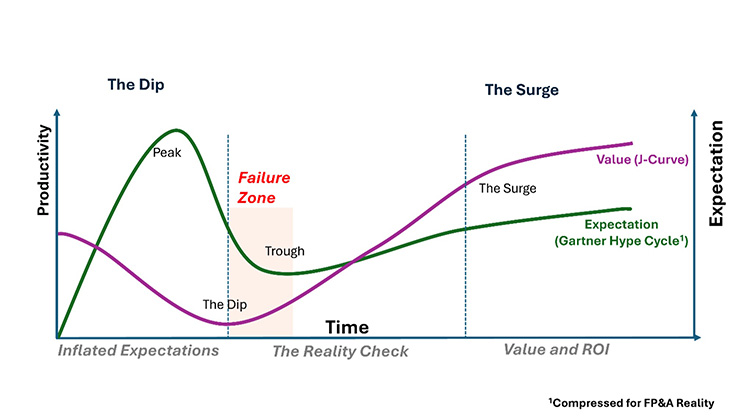
Most finance leaders know the Gartner Hype Cycle: Expectations inflate to a peak, crash to a trough of disillusionment, then recover through a slope of enlightenment. It is a useful framework, but it was designed to describe industry-wide adoption over years or decades. At the organizational level, that arc compresses into a single budget cycle, and the trough carries real consequences: stalled projects, exhausted sponsors, budget reclaimed for something else.
What receives less attention is a second curve: actual project productivity. When a new technology deploys, productivity dips before it recovers in a well-documented J-curve (Graphic 1). That overlap is the “failure zone,” where confidence is low and abandonment is most likely. Organizations that escape it are the ones whose J-curve inflects before patience runs out. Those that do not conclude the technology failed and start the cycle again with a different tool.
GRAPHIC 1 — Hype vs. Reality Curve (with strong foundation)
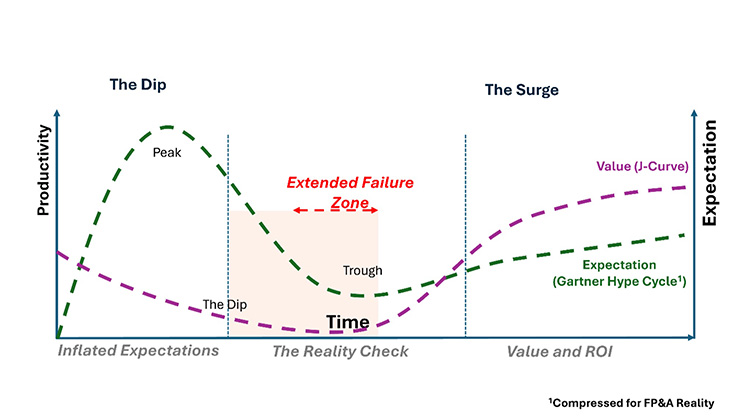
When AI is deployed onto weak foundations — inconsistent definitions, undocumented logic, no clear ownership — the J-curve dip goes deeper into the trough of disillusionment, expanding the failure zone (Graphic 2). The escape path, called the slope of enlightenment, cannot begin because the tool produces unreliable outputs on broken data. Both curves stay low until the foundation problem is fixed—or the team abandons the project.
GRAPHIC 2 — Hype vs. Reality Curve (with weak foundation)
The Three Phases of AI-Ready FP&A and the Trap Between Them
The way out of the failure zone is through the correct sequencing of AI-Ready FP&A. Despite the pressure of board expectations, vendor timelines and the very human desire to skip to the end, it is critical to know that the path to success runs through three phases, and each is a prerequisite for the next. Getting them right, and in the right order, can accelerate your path to success.
| Phase | What it means | FP&A outcome |
|---|---|---|
| Phase 1 Data Integrity | The foundation layer. This includes clean data with agreed metric definitions across every business unit, documented logic and explicit ownership. It is the substrate on which everything above it either holds or collapses. | Reliability and trust: consistent taxonomy across units enables faster close cycles, fewer reconciliation loops, and reporting every business unit can stand behind. |
| Phase 2 AI Enablement | Technology as a multiplier. AI on clean, governed data produces trustworthy outputs. This is where the J-curve inflects and investment begins compounding into genuine gains. | Speed and scale: FP&A shifts from data assembly to analysis, and from reporting to business partnering. |
| Phase 3 Strategic Influence | The finance function as the decision architect. FP&A is embedded in capital allocation and M&A decisions and uses real-time scenario modeling and continuous planning. | Influence: FP&A shapes decisions, not just reports. |
The failure zone sits between Phase 1 and Phase 2. Moving ahead before being fully prepared will actively degrade Phase 1 data integrity, automating bad logic, scaling inconsistent definitions and creating technical debt that costs more to fix than the original remediation would have.
Before moving from Phase 1 to Phase 2, organizations need to make sure they can answer yes to the following three questions.
| Diagnostic question | If NO |
|---|---|
| 1. Can we define every metric this tool will process, in writing, with agreement across all business units? | Define every metric in writing before deployment. Document the business definition, source system, calculation logic, owner and refresh cadence. Where definitions conflict across units, resolve them at the source. If sales defines ARR from bookings, finance from billings and customer success from active subscriptions, alignment is a business conversation, not a data cleaning task. |
| 2. Is data ownership documented and enforced for every element this tool will consume? | Assign a named owner for each critical data element before deployment. Document who approves changes, resolves exceptions and signs off on quality. When the business changes, and it will, that owner is responsible for keeping the model aligned with the reality it is meant to reflect. |
| 3. If this tool were removed tomorrow, would we understand what it had been doing? | Map the workflow before you automate it. For each output the tool will produce, document the inputs, assumptions and thresholds that drive it. When the AI flags a customer as churn risk or adjusts a working capital assumption, Finance should be able to walk any stakeholder through the reasoning in plain language. |
There is one exception: Early-stage organizations sometimes need lightweight tools first to understand what data they have. That is legitimate exploration. But AI is not a discovery tool. It learns from whatever it is given. Deploying sophisticated AI before the foundation is ready does not reveal the problem but encodes it.
The Strategic Implication
Finance teams with strategic influence share one characteristic: They resisted the pressure to deploy AI before the foundations justified it. Their FP&A cycles are shorter because their data is clean enough to close fast. Their CFOs shape capital decisions, not quarterly narratives.
Most organizations will blame the tool. They will select a different platform, sit through another demo, approve another budget. The failure zone returns — deeper, because the organization now carries the technical debt of the previous deployment on top of the foundation problems it never fixed.
The gap between hype and harvest is not a technology problem. It is a sequencing problem that is entirely within the control of the finance leader reading this.
Copyright © 2026 Association for Financial Professionals, Inc.
All rights reserved.

 Search the AFP Answer Engine
AFP Membership
The Hub for Treasury and Finance Professionals
As an AFP member, you'll gain access to exclusive training, certifications, research and networking to advance your career.
AFP Newsletters
Unbiased, practitioner-driven information for treasury and finance professionals
Subscribe to an AFP Newsletter to receive the latest news, events and trends in FP&A, Treasury or career planning.