

Articles
I’m a 30-Year FP&A Exec. This Is What I Learned from Breaking a Financial Model with AI.
- By Jeff Altman
- Published: 5/21/2026

Let me start with a confession. I broke a financial model. Badly.
I was building a customer lifetime value model for a subscription industry, working iteratively with Claude in Excel. The model was coming along well. The analyst I was working with liked the first pass. So did I.
And then I kept tweaking it. "Just add this, make this adjustment, one more chart."
The model degraded, and by the end, the numbers didn't tie. The charts were misleading. I wasn’t even sure what I was trying to show anymore. I'd wasted hours chasing my own tail.
So, I did something that felt almost too simple: I deleted the output dashboard tab and started over.
AI in Finance Certificate
The No Code AI for Finance Certificate program is built for finance professionals who want real, usable AI skills today. Learn to implement AI responsibly, transparently and in a way that strengthens decision-making across your organization.
Learn MoreBuilding is where the learning happens
Thirty minutes later, I had a clean, working dashboard because this time, I knew exactly what I wanted before I started building.
There's a version of AI adoption that finance leaders tend to take — attend a webinar, nod along, tell our teams to start using it and then file it away.
I understand the impulse. We're busy. The tools are evolving faster than most of us can comfortably track. And there's something uncomfortable about being a senior finance professional and feeling like a beginner again.
But the real learning doesn't happen in a course module. It happens when you’re staring at a model that isn't working and you have to figure out why.
First versions are supposed to be rough
Here's something I didn't expect: First versions are supposed to be rough. With AI, the first pass gets you 70% of the way there. Fast.
The trap is thinking that faster means you can (or should) keep iterating indefinitely. It doesn't.
Each iteration adds complexity, and complexity is the enemy of a clean model. Too many "just one more" tweaks and you end up where I did — with a dashboard you don’t recognize.
The lesson isn't to iterate less; it's to know what you're building before you start. The first build is for discovery. The second build is for execution — and it’s almost always faster, cleaner and better because you've earned the clarity.
The corollary lesson is that when working with AI, too much tinkering can break a model, but the cost of starting over is low. Knowing when to delete and start over is a skill. It doesn't feel like one at the moment. It feels like defeat. But letting go of a flawed build and rebuilding with clear intent is one of the highest-leverage decisions you can make in a modeling exercise.
AI as collaborator, not calculator
After the model was working, I tried something I hadn't done in the initial build: I asked Claude to challenge my assumptions. Not to build something new — to push back on what I'd already built. Tell me what looked wrong. Tell me what should change and why.
For example, I had a specific approach to how I was applying customer tenure in the model. Claude flagged it, offered an alternative, and we went back and forth until we landed on a methodology aligned with industry standards.
I hadn't been wrong, exactly. But I hadn't been as rigorous as I could have been, and the back and forth surfaced that gap.
That conversation changed how I think about AI as a modeling tool. The value isn't just speed. It's having a collaborator that will push back on your logic without political hesitation — one that doesn't care about hierarchy or how long you've been doing this. It just asks: Does this hold up?
Experience isn't a liability in an AI-enabled world — it's the multiplier
Knowing what a model should look like before it's built. Knowing which assumption is the one that breaks everything. Knowing when a number feels wrong before you can articulate why. That's not something a course gives you. It's not something AI gives you. It’s what experience gives you.
As it turns out, experience is exactly what makes AI output useful rather than dangerous. Weak assumptions get amplified by AI just as much as strong ones do. The model doesn't know that your churn rate assumption is too optimistic. It doesn't know that the tenure methodology doesn't match the industry. You know that.
This is where senior finance professionals have a genuine advantage. Human judgment in the loop is the safeguard. Without it, you're just producing flawed outputs faster.
What this means for you
I'm still in the middle of this journey. After 30+ years in finance, I made a deliberate decision: I was going to get serious about AI. Not read-about-it serious. Build-with-it serious.
I'm building things I'll break and rebuild. I'm asking better questions than I was six months ago, and I expect to be asking still better ones six months from now.
Financial modeling is no longer a static exercise. It's a conversation — iterative, dynamic and collaborative in a way it simply wasn't when I was running FP&A teams at Verizon.
That's not a threat to the finance profession. It's an upgrade.
But only if you engage with it. Reading about it isn't enough. Watching a demo isn't enough. You have to build something, break it and figure out why it doesn’t work.
The tools will meet you where you are. The question is whether you're willing to show up.
About the author
Jeff Altman left Verizon earlier this year after 30+ years working primarily in Finance across FP&A, Internal Audit and Treasury. An avid lifetime learner, Jeff is focused on upskilling, particularly around AI and how it can be applied in a team environment. His wife is convinced he is having an online relationship with somebody named “Claude.” Connect with Jeff on LinkedIn.
Copyright © 2026 Association for Financial Professionals, Inc.
All rights reserved.
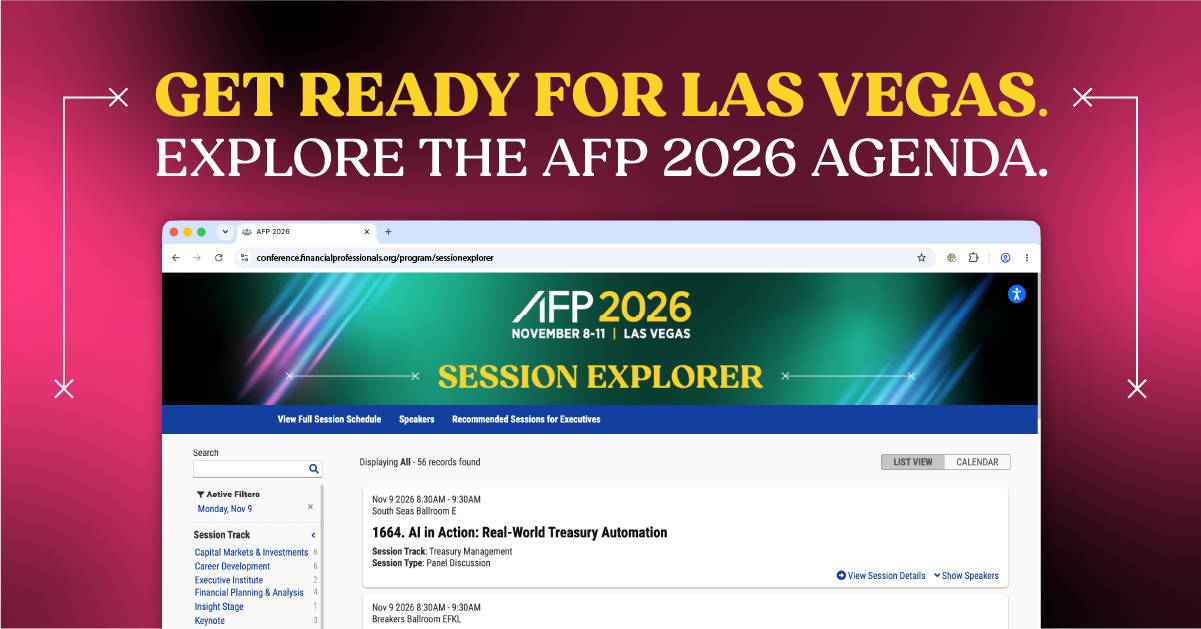
🔍 Browse 140+ sessions by day or track
💡 Discover the speakers sharing
real-world treasury and finance strategies
🤝 Find networking experiences designed
to help you connect with peers
📅 Build your plan before you arrive
Start Exploring
AFP Membership
The Hub for Treasury and Finance Professionals
As an AFP member, you'll gain access to exclusive training, certifications, research and networking to advance your career.
AFP Newsletters
Unbiased, practitioner-driven information for treasury and finance professionals
Subscribe to an AFP Newsletter to receive the latest news, events and trends in FP&A, Treasury or career planning.