


Articles
25 Questions Every Portfolio Company Finance Team Should Be Prepared to Answer for Its New Private Equity Owner
- By Bryan Lapidus, FPAC
- Published: 7/30/2026

The new private equity (PE) owner of your company has arrived, and your finance team must adjust to a new reality. Reporting requests are arriving more often, forecast assumptions are being scrutinized more closely, and questions that were once relegated to an annual planning cycle now come up weekly.
What the PE owner wants to know is whether the business can generate reliable cash flow, execute the value creation plan and deliver the return envisioned when the deal was made.
In a previous article, I asked what portfolio company (PortCo) finance teams should ask a new PE owner. This time, I reversed the question: What should finance teams be prepared to answer from their PE owners?
I asked the AFP community of finance professionals for their thoughts. Below are the questions they recommend being prepared for, along with some additional insights.
Financial Performance and Cash Generation
In this category of questions, PE owners are seeking to understand whether the reported performance is sustainable and capable of generating cash. EBITDA is an important starting point, but owners will also examine earnings quality, working capital, margins, forecast accuracy and the assumptions supporting the numbers.
The following questions examine the quality and durability of financial performance, the company’s ability to convert earnings into cash and the risks embedded in its forecasts.
- What does normalized cash flow and financial performance look like? – Marcus Gadson, AVP of Capital Management, Ascension
- What does the 13-week cash flow forecast look like, and where are the variance bottlenecks? – Valerie Nielsen, Managing Director, Inside Edge Risk Advisory LLC
- How much working capital is trapped in accounts receivable and inventory? – Valerie Nielsen
- Which customer segments or product lines are driving true gross margin, and which are dragging it down? – Valerie Nielsen
- Where is the spending that has not been benchmarked in three years, and how quickly could savings convert to recurring EBITDA? – Consulting Partner at a middle market advisory
- If we had to sell the business in 90 days, what is the number, and what is the story? – Beverly Davis, Founder, Davis Financial Services
“Finance teams should be prepared to demonstrate not only reported performance, but whether that performance is real, repeatable and cash generative. That requires clear, evidence-backed answers on EBITDA quality, cash conversion, working capital, margin durability, forecast confidence and debt-like exposures before the challenge arrives,” said Shekhar Kohli, Creator of CERD, Capital Event Readiness Diagnostic. When your finance team can answer these questions, you demonstrate your understanding of the economics behind the reported results, not merely the numbers themselves.
Execution Capacity and Organizational Alignment
The value creation plan may be established at the top, but its success depends on the team’s ability to carry it out. PortCos often have more initiatives than they have people, time or resources, making execution capacity a significant concern.
Questions in this category seek to discover whether your company has the people, resources, incentives and organizational flexibility needed to deliver the value creation plan. “Most PortCos do not need more reporting; they need sharper prioritization from the sponsor,” said Barry Huisman, CFO, OQ RPI and Polymers.
- Who are the key employees driving business performance and growth? – Marcus Gadson
- What breaks first if growth doubles next year? – Smith Lordeus, Manager, Financial Planning and Analysis, XKIG
- Whose incentives are misaligned with where we’re trying to take the business? – Smith Lordeus
- Are there any commitments that constrain the company’s flexibility? – Aaron Wilkins, Entrepreneur, CEO & CFO
Rosemary Linden, President of Momentum CFO, described execution capacity as the “ultimate constraint,” noting that “PortCos fail from too many concurrent priorities, not a lack of ideas.”
Anna Tiomina, Founder of Blend2Balance, similarly identified bandwidth as a hidden bottleneck: “We are often resource-constrained in ways that limit how fast we can execute on the PE owner’s priorities,” she said.
Middle management is also critical. As Linden noted, “Strategy is set at the top, but execution lives in the middle. If middle management is not aligned with the value creation plan, results will fall short.”
"Finance teams should expect PE owners to test how well the business is actually run, not just how well it is reported,” said Davis.
Finance Maturity and Decision Support
Faster and more are often the adjectives used to describe PE ownership’s expectations of finance. Where you previously relied on annual budgets and monthly reporting, you may suddenly be expected to provide weekly cash visibility, rolling forecasts, scenario analysis and investor-grade reporting.
The questions in this category examine whether your finance team can produce timely, forward-looking insights and identify changes in business performance before they become bigger problems.
- What three drivers explain 80% of your variance, and what are you doing about them? – Jason Brisbane, CEO, FinHelm
- Walk me through your forecast accuracy over the last four quarters. Are the misses random, or are you consistently missing in the same direction? – Jason Brisbane
- How fast can you produce a clean rolling forecast under stress? – Consulting Partner
- Which metrics are leading versus lagging, so the business avoids relying on vanity metrics? – Smith Lordeus
- Where does the business misunderstand the financial reality, and how does finance handle that tension? – Beverly Davis
- What assumptions are you least confident in, and what bad news would you feel comfortable giving me tomorrow in the board pack? – Aaron Wilkins
“Finance maturity at the PortCo is often the real bottleneck to value creation and exit,” said Huisman. “PortCo forecasts are not just reporting outputs; they are early indicators of whether the original equity story still holds, especially when margin timing slips, receivables quality deteriorates, capex benefits are delayed or budget phasing was overly optimistic.”
Trust and communication style also affect the quality of decision support. “It matters more than most PEs realize,” said Tiomina. “How you engage us shapes how much we tell you.”
Systems, Data and FP&A Infrastructure
“The data and reporting the PE owner expects may not exist yet, and building it takes time and investment before it adds value,” said Tiomina. PortCos often rely on disconnected systems, manual spreadsheets or data designed primarily for accounting rather than forward-looking planning and performance management.
The following questions examine whether your company’s systems, data and finance infrastructure can support the reporting, forecasting and analysis the PE requires.
- What finance investment would have the greatest impact on the business? – Rosemary Linden, President, Momentum CFO
- What systems does the finance function use, what limitations exist in those tools and what’s your confidence in the quality of the data? – Aaron Wilkins
Linden further emphasized that without adequate FP&A infrastructure, the business will struggle to produce the reliable, forward-looking insights leadership needs.
Market Position and Growth Opportunities
A PE owner invests based on expectations for how the company can grow, improve and increase in value. Finance should therefore understand more than internal financial results; it also has to recognize the market forces and competitive dynamics shaping the business.
The questions in this category examine specific drivers of growth, your company’s competitive position and opportunities that could strengthen the original investment, requiring finance to look beyond historical performance.
- What is your company’s competitive position? – Larry Maisel, President, DecisionVu Group
- What new products and services are currently in development? – Larry Maisel
- What are the industry trends and the PortCo’s comparative advantage? – Raymond Cheung, VP, Corporate Finance & Strategy
- What potential bolt-on opportunities in the industry could maximize synergy? – Raymond Cheung
- What part of the original deal thesis no longer fits the business today? – Smith Lordeus
Revisiting the original investment thesis regularly enables your company and its owner to identify what’s strengthened, weakened or materially changed since the deal closed.
Culture and Business Risk
Some of the greatest threats to value creation don’t necessarily appear immediately in the financial statements. Leadership behavior, organizational culture, legal exposures and other embedded risks can affect your company’s ability to execute its plans and achieve a successful exit.
The following questions examine the cultural and liability risks that could constrain the business, disrupt execution or reduce its value.
- Which elements of the company’s culture support the value creation plan, and which behaviors or management dynamics could prevent its execution? – Jeff Zielinski, CFO, Buy&Ship
- What professional and general liability risks exist, including past legal settlements? – Marcus Gadson
Zielinski further noted that the psychology of senior management can have a significant effect on how the organization operates, and that culture can remain deeply embedded over time — for better or worse. Finance may not own culture or legal risk, but it can help make their economic consequences visible.
Copyright © 2026 Association for Financial Professionals, Inc.
All rights reserved.
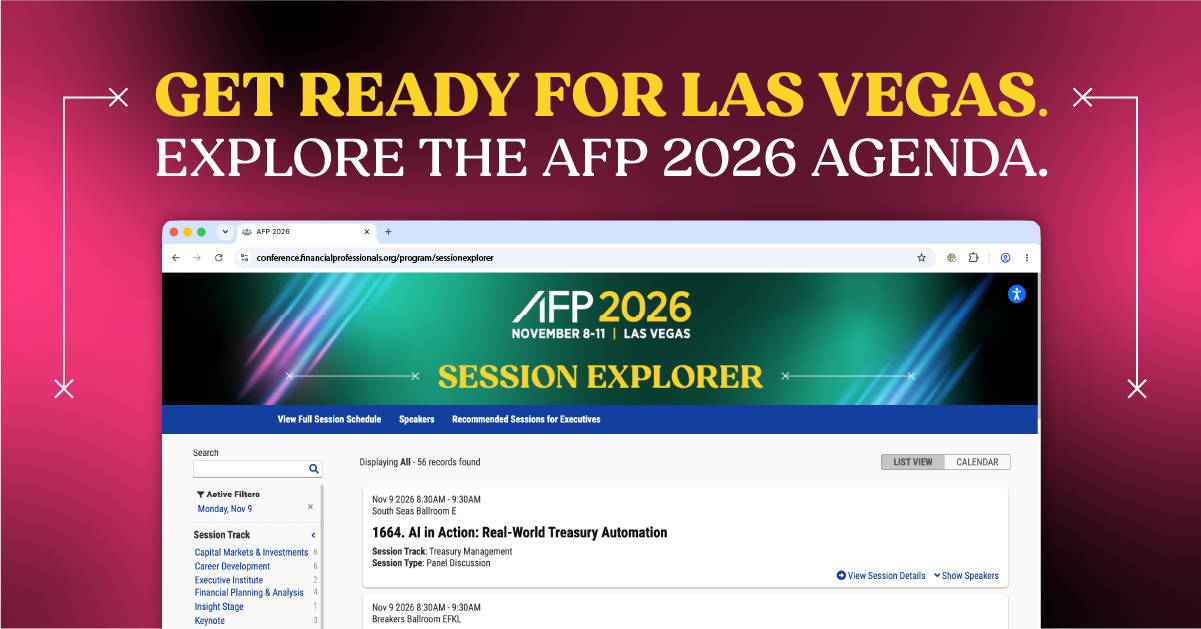
🔍 Browse 140+ sessions by day or track
💡 Discover the speakers sharing
real-world treasury and finance strategies
🤝 Find networking experiences designed
to help you connect with peers
📅 Build your plan before you arrive
Start Exploring
AFP Membership
The Hub for Treasury and Finance Professionals
As an AFP member, you'll gain access to exclusive training, certifications, research and networking to advance your career.
AFP Newsletters
Unbiased, practitioner-driven information for treasury and finance professionals
Subscribe to an AFP Newsletter to receive the latest news, events and trends in FP&A, Treasury or career planning.