


AI in Finance

Artificial intelligence (AI) is increasingly becoming embedded in forecasting, planning and fraud detection, impacting how the office of the CFO analyzes data, manages risk and supports strategic decision-making.
At the same time, the rapid evolution of technologies such as generative AI and AI agents has raised important questions for finance leaders. What exactly does “AI in finance” look like? Where does it deliver real value today, and where does it fall short? And how can finance teams adopt AI responsibly, with appropriate governance, transparency and oversight?
This page provides a practical overview of AI in finance, explaining what it is, why it matters and how organizations are applying it. It also examines the benefits, risks and ethical considerations associated with AI adoption, and offers guidance on how finance professionals can stay informed as the technology continues to evolve.
Quick Navigation
- AI in Finance Certificate
- What Is AI in Finance
- Real-World Use Cases of AI in Finance
- Benefits of AI in Finance
- Challenges and Risks of AI in Finance
- AI Governance and Ethical Considerations in Finance
- Staying Current with AI in Finance
- Frequently Asked Questions About AI in Finance
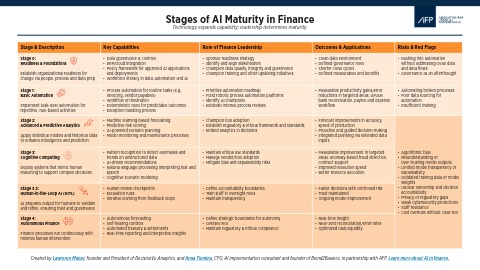
Complimentary Infographic: Stages of AI Maturity in Finance
AI maturity in finance is not just technical — it is also managerial. The progression of finance organizations reflects not only advances in technology but also growth in data management discipline, governance, workforce skills and leadership mindset. Finance does not become “intelligent” through tools alone — it becomes intelligent through the structured integration of automation, analytics, cognitive models and human oversight.
The stages of AI maturity demonstrate how organizations move from foundational readiness to task automation, predictive decision support and, ultimately, toward autonomous, continuously optimizing finance operations. At each stage, the role of senior finance leaders expands from establishing data governance and funding foundational capabilities to championing predictive insights and serving as stewards of responsible, ethical AI deployment.
This infographic illustrates the key characteristics of each maturity stage, along with the role of leadership, measures of success and risks to monitor, enabling organizations to assess where they are today and what is required to progress confidently and responsibly.
Progression through the maturity stages is driven as much by leadership as by technology. The finance function sets the standards for data quality, governance and responsible use, creating the conditions in which AI can operate effectively. In this context, the CFO is a steward of both capability and accountability.
Fill out the form below to download the complimentary infographic.
About the Infographic Authors
Lawrence Maisel, founder and president of DecisionVu Analytics, is a business advisor, former CFO and KPMG Consulting Senior Partner with over 30 years of experience in AI-enabled analytics, performance and corporate financial management and business optimization. Currently, he is a member of AFP’s FP&A Advisory Council.
Anna Tiomina is an AI implementation consultant and founder of Blend2Balance. A former CFO, she now helps finance leaders harness AI responsibly, with a focus on governance, compliance and practical adoption frameworks.

AI in Finance Certificate
The No Code AI for Finance Certificate program is built for finance professionals who want real, usable AI skills today. Learn to modernize workflows, elevate analysis and lead AI adoption in your finance team with confidence.
Learn MoreWhat Is AI in Finance
Artificial intelligence (AI) in finance refers to the application of advanced computational techniques to systems that help financial professionals analyze large volumes of data, identify patterns and generate insights that support strategic decision-making.
Traditional workflow processes and analytics rely on predefined rules to create deterministic, predictable outcomes. In contrast, AI systems generate probabilistic outcomes; they learn from data, adjust over time and estimate the desired outcome. This means they can produce something new, but the process may potentially be opaque and non-repeatable.
With increased processing power and speed, finance teams can dig deeper into their data, use machine-generated or machine-guided analytics, and quickly produce a range of work products that advance finance's role in fiscal management.
AI is not a single technology but an umbrella term that covers multiple approaches, including:
- Machine learning (ML): A subset of AI where algorithms enable computers to analyze historical data, identify patterns and apply those patterns to new data to make predictions or decisions. It needs clean, structured data and often requires data scientists to scale. Examples of how it can be used in finance include identifying anomalies in spending patterns and predicting future cash positions by analyzing historical seasonality and macroeconomic indicators.
- Generative AI (GenAI): A subset of machine learning that can create new content (such as text, images and audio) based on patterns learned from massive datasets. It approximates human understanding of language, voice and visuals. Examples of how it can be used in finance include generating charts from raw Excel data and drafting an executive summary of an investor research report.
- Large language model (LLM): A subset of generative AI that is trained on a vast amount of text to understand, summarize and predict human language. It takes user input (such as questions or prompts) and generates text responses based on the dataset it was trained on. Examples of how it can be used in finance include summarizing key points from the transcript of an earnings call and finding the answer to a specific question in a policy document.
- AI chatbot: A software interface, powered by large language models, that simulates human conversation with the user. Examples of AI chatbots include ChatGPT, Gemini and Microsoft Copilot. AI chatbots are a common way finance professionals interact with AI in their day-to-day work, whether it is drafting emails or conducting research.
- AI agent (agentic AI): A software system, often powered by large language models and connected to other software tools, that can perceive a request, reason out a plan and execute actions autonomously or semi-autonomously. While it can streamline workflows, it’s most effective when paired with human oversight and clearly defined controls. Examples of how it can be used in finance include automating the procurement process and flagging anomalies within an enterprise resource planning system for human review.
Automation, the use of technology to perform repetitive, deterministic tasks with minimal human assistance, is often combined with AI to handle more complex tasks, such as matching transaction lines from bank statements to the general ledger. Automation is also useful in streamlining the data that flows into AI processes
Across all of these applications, successful AI deployment in finance depends on the quality and integrity of the underlying data. Equally important is transparency into how models reach their conclusions, which is why explainable AI in finance has become a priority for organizations operating in highly regulated and risk-sensitive environments.
Related AFP resources
- AFP FP&A Guide to AI-Powered Finance
- AFP's Video Guide to Building an AI Agent
- Predictive Analytics
- Prescriptive Analytics
Real-World Use Cases of AI in Finance
AI is being applied across a wide range of finance functions, helping teams improve accuracy, efficiency and insight in both operational and strategic activities. While adoption varies by organization, several use cases have emerged as particularly impactful.
One of the most common applications of AI in finance is forecasting and planning. AI models can analyze and integrate historical performance, external variables and real-time data to generate more dynamic forecasts and scenario analyses. This is especially valuable in FP&A, where teams are expected to respond quickly to changing business conditions and assess trade-offs before decisions are made.
AI also increasingly plays a role in risk management, fraud mitigation and anomaly detection. By monitoring transactions and identifying unusual patterns, such as unexpected spikes in forecasted amounts or general ledger line items that are out of bounds, AI-powered systems can flag potential risks earlier and with greater precision than manual reviews alone. These capabilities are more important as payment volumes grow and fraud schemes become more sophisticated.
In financial close, reporting and compliance, AI can support data reconciliation, variance analysis, and invoice-to-payment matching to reconcile transactions. Automating routine checks helps reduce errors and accelerates close timelines, while allowing finance professionals to focus on interpretation and oversight rather than data cleanup.
Other use cases include treasury and cash management, where AI can help forecast cash positions, assess liquidity risks and analyze FX exposure, and revenue and customer analytics, where AI supports more accurate revenue forecasting and retention strategies. Across these applications, AI is most effective when embedded into existing finance workflows and paired with strong governance and human review.
Related AFP resources
- 3 AI and Machine Learning Use Cases in Finance
- Use Cases for Generative AI
- An In-House AI Solution to Improve FX Exposure Forecasting Accuracy
- Applying AI to an EPM System
- Incorporating AI into Revenue Forecasting
- Incorporating AI into a Customer Retention Program
Benefits of AI in Finance
When applied thoughtfully, AI delivers tangible benefits that extend beyond automation. For finance teams, the primary value lies in improved decision-making and greater efficiency.
One of the most significant benefits of AI in finance is enhanced accuracy and insight. Finance teams operate in an environment defined by growing data volumes and increasing complexity. By analyzing large datasets and identifying patterns that may not be immediately visible, AI can improve forecasts, highlight emerging risks and surface actionable insights. This allows finance leaders to move beyond static reporting and toward more forward-looking analysis.
AI also drives efficiency and scalability. Finance teams often work with limited resources and tight timelines. Automating routine tasks, such as data validation, reconciliation and variance analysis, reduces manual effort and shortens cycle times. As organizations grow and data volumes increase, AI-enabled processes can scale without a corresponding increase in workload. Furthermore, AI can help finance teams review data that they otherwise would not have time to analyze.
In a nutshell: AI shifts how finance teams spend their time. By handling labor-intensive tasks, AI enables professionals to focus on higher-value activities, such as strategic planning and business partnering. In this way, AI acts not as a replacement for finance expertise but as a force multiplier that enhances the impact of skilled teams.
Related AFP resources
Challenges and Risks of AI in Finance
Despite its potential, AI adoption in finance is not without challenges. Finance teams operate in highly regulated, risk-sensitive environments, and the use of AI means new considerations related to data integrity, model transparency and operational control.
One of the most significant risks is data quality and bias. AI systems learn from historical data, so errors, gaps or biases in that data can be amplified in AI-driven outputs. In the case of LLMs and AI chatbots, hallucinations, where the AI generates incorrect or misleading results, are also a risk. Without careful data governance and validation, models may produce results that appear precise but are ultimately misleading.
Another challenge with AI is model transparency and explainability. Many AI models operate as “black boxes,” making it difficult to understand how conclusions are reached. In finance, where decisions must often be explained to regulators, auditors and senior leadership, this lack of transparency can pose serious issues. As a result, explainable AI in finance has become a priority, ensuring outputs can be understood, challenged and defended.
AI also introduces operational and compliance risks. Overreliance on automated outputs, unclear accountability and insufficient oversight can lead to errors or inappropriate decision-making. Finance teams must clearly define where AI supports decisions and where human judgment remains essential.
Finally, there is the cost and implementation complexity. Deploying and maintaining AI solutions requires investment in technology, data infrastructure and skills. This may require upskilling current staff and/or hiring additional staff with the necessary skill set. Organizations that approach AI without a clear strategy or expectations grounded in reality may struggle to achieve meaningful returns.
Related AFP resources
- The Role of AI in Forecasting and Where It Falls Short
- The Role of Prompt Engineering in Finance and Where It Falls Short
- Ways FP&A Leaders Manage the Costs of AI in Finance
AI Governance and Ethical Considerations in Finance
As AI becomes more embedded in finance processes, strong governance and ethical oversight become essential. Finance leaders are ultimately accountable for the decisions informed by AI, which makes transparency, control and responsibility non-negotiable.
A core element of effective governance is clear accountability. Organizations must define who owns AI models, how they are monitored and how issues are escalated when outputs raise concerns. AI should support decision-making, not obscure responsibility or shift accountability away from finance leadership.
Ultimately, effective AI governance balances innovation with discipline. By establishing clear policies, maintaining human-in-the-loop oversight and embedding ethical considerations around data usage and bias management into AI initiatives from the outset, finance teams can adopt AI in ways that are both responsible and sustainable.
Related AFP resources
- Four Rules for Your AI Journey
- 4 Questions About Embracing AI in Finance, Answered
- Generative AI in Finance: 2 Big Questions, Answered
Staying Current with AI in Finance
AI in finance is evolving quickly, but staying current doesn’t require mastering every new tool or trend. For finance professionals, the most important priority is building a foundational understanding of how AI works, where it adds value and how it should be governed within their organization.
Continuous learning plays a key role. Many finance teams are exploring AI in finance courses, workshops and practical guides that focus on real-world applications rather than technical theory. These resources help professionals develop the confidence to ask the right questions, evaluate AI-driven insights, and participate meaningfully in conversations about adoption and oversight.
Equally important is a mindset of thoughtful experimentation. As AI capabilities expand, finance leaders benefit from testing use cases in controlled environments, learning from results and refining approaches over time. Staying informed also means engaging with trusted industry resources and events, such as the AFP FP&A Forum and AFP Conference, that share practical insights, case studies and lessons learned from peers.
Ultimately, keeping pace with AI in finance is about aligning technology with purpose. By focusing on education, governance and strategic application, finance professionals can ensure AI supports — rather than distracts from — the work that matters most.
Related AFP resources
- AFP FP&A Guide to AI-Powered Finance
- AFP’s Video Guide to AI Prompting for Finance Professionals
- AI Prompts for Finance: 15 Real-World Examples
- AFP Digital Badge: AI in Treasury
Frequently Asked Questions About AI in Finance
What is AI in finance?
AI in finance refers to the use of advanced algorithms and models to analyze financial data, identify patterns and support decision-making. It is used across functions such as forecasting, risk management, fraud detection, treasury and financial reporting to improve accuracy, efficiency and insight.
What is generative AI in finance?
Generative AI (GenAI) in finance focuses on creating new content or outputs, such as summarizing financial information, drafting analyses or enabling natural-language interaction with data. When used responsibly, GenAI can help finance teams work more efficiently by accelerating analysis and communication.
How are AI agents used in finance?
AI agents in finance are systems designed to perform specific tasks autonomously or semi-autonomously, such as monitoring transactions, reconciling data or flagging anomalies. These agents are most effective when operating within defined controls and supported by human oversight.
Why is explainable AI important in finance?
Explainable AI in finance ensures that AI-driven outputs can be understood and justified. This is critical in regulated environments where decisions must be explained to auditors, regulators and senior leadership, and where transparency supports trust and accountability.
Do finance professionals need AI courses?
While deep technical expertise is not required, many finance professionals benefit from AI courses or practical learning resources. Programs like AFP's No Code AI for Finance Certificate help build foundational understanding, improve confidence in evaluating AI outputs and support responsible adoption within finance teams.
AFP Original Research
Cost of Capital Survey
If you are reviewing your weighted average cost of capital (WACC) assumptions, validating your hurdle rate policy or reassessing discount rate inputs, this report shows how your approach compares to peer organizations. See the Results.