


Articles
Optimizing the Month-End Close: Lessons from the Front Lines of Finance
- By Ebele Lydia Nwani
- Published: 8/26/2026

For many finance professionals, the month-end close feels like a race against the clock. Success is often measured by one number: how quickly the books close. Early in my career supporting FP&A at a global manufacturing organization, I shared that perspective. Like many finance professionals, I believed that shortening the close cycle was the ultimate measure of an effective finance organization.
Experience taught me otherwise. Every month followed a familiar pattern. During the first three weeks, finance teams focused primarily on daily operational demands while many critical close activities, including balance sheet reconciliations, accrual reviews, inventory variance investigations and account analysis, were postponed until the final week of the month. As reporting deadlines approached, the accounting, FP&A, and operations teams worked simultaneously to resolve outstanding questions, process journal entries, and complete management reviews.
No one lacked commitment. Everyone worked exceptionally hard. The problem wasn't the people; it was the process.
By allowing work to accumulate until month-end, we unintentionally created bottlenecks that no amount of overtime could consistently overcome. Late adjustments delayed reporting, management spent valuable time reviewing corrections instead of discussing business performance, and FP&A teams often had to postpone meaningful financial analysis until after the financial statements were finalized.
The challenge was particularly evident in a manufacturing environment, where inventory transactions, production variances, standard costing and operational issues often required collaboration across finance and plant operations. Questions that could have been resolved earlier in the month instead surfaced during the busiest days of the close, increasing pressure on everyone involved.
Finance leadership recognized that asking people to work harder during close week would never solve the underlying problem. Instead, we redesigned the process to make the close more efficient, reduce manual effort and spread key activities more evenly throughout the reporting cycle. As the close became more predictable and required fewer last-minute resources, the same finance team could redirect time toward analysis, business partnering and operational support. This created additional capacity without increasing headcount, allowing finance to support a larger and more complex business while maintaining the same level of staffing.
Looking back, this experience fundamentally changed my understanding of what an optimized month-end close should accomplish. The objective isn't simply to close the books faster. The objective is to create a disciplined financial process that delivers reliable information early enough for finance to become a strategic business partner.
Lesson 1: Bottlenecks Begin Long Before Close Week
One of the most valuable lessons from this experience was that month-end delays rarely originate during the close itself. They usually result from work that accumulates throughout the accounting period.
At our organization, unresolved reconciliations, incomplete accruals and unanswered operational questions gradually built up over several weeks. By the time the official close began, finance teams were attempting to complete multiple complex activities simultaneously while still meeting reporting deadlines.
The solution wasn't to accelerate work during the final week; it was to change what happened throughout the month.
Lesson 2: Continuous Reconciliation Improves Both Speed and Accuracy
Perhaps the single most important operational improvement we implemented was moving from periodic reconciliation to continuous accounting.
Instead of waiting until month-end to investigate account balances or explain significant variances, finance teams completed selected reconciliations throughout the month. Weekly collaboration between accounting, FP&A and operations allowed discrepancies to be identified while transactions were still recent and business context remained readily available.
The benefits extended far beyond reducing close cycle time. Earlier reconciliations improved data quality, reduced rework and increased confidence in financial reporting before the official close process even began.
Lesson 3: Cross-Functional Collaboration Eliminates Last-Minute Surprises
Although the month-end close is often viewed as an accounting responsibility, our experience demonstrated that successful closes depend on collaboration across the organization.
The weekly meetings introduced during our transformation became one of the most valuable process improvements. Representatives from accounting, FP&A, and operations reviewed unusual transactions, discussed production issues, evaluated inventory-related impacts, and resolved outstanding questions before they became reporting delays.
The discussions produced benefits well beyond the close itself. Operational leaders gained greater visibility into how business activities affected financial reporting, while finance developed a deeper understanding of the operational drivers behind financial results.
Those conversations significantly reduced the number of unexpected issues that traditionally surfaced during close week.
In many ways, the meetings became less about closing the books and more about improving communication across the business.
Lesson 4: Technology Amplifies Good Processes
As our process matured, technology became an important enabler, but not the starting point.
Like many organizations, we relied heavily on spreadsheets for reconciliations, journal entries and reporting. While these tools were familiar, they also consumed valuable analyst time and increased the likelihood of manual errors.
Automation technologies, including workflow automation, robotic process automation (RPA) and artificial intelligence (AI), can substantially reduce repetitive work by matching transactions, identifying reconciliation exceptions, monitoring task completion and distributing standardized reports.
However, our experience demonstrated that technology cannot compensate for poorly designed processes. Organizations that automate inefficient workflows often accelerate the wrong activities. By contrast, organizations that first standardize responsibilities, establish governance and improve communication create an environment where automation delivers far greater value.
Measuring Success Beyond Close Cycle Time
Perhaps the most significant lesson we learned was that success should not be measured simply by how quickly the close was completed, but by the value finance created throughout the reporting cycle. We began measuring success through indicators that allotted more time for analysis and for finance’s ability to support operational and strategic decisions, such as reducing post-close journal entries, improving reconciliation quality, increasing automation rates and shortening management review time.
This shift changed how we evaluated the close process: The goal was no longer just to “close the books” faster, but to build a more efficient finance function that could provide greater value to the business with the same resources.
From Reporting Process to Strategic Capability
Looking back on that manufacturing organization, I realize our greatest achievement wasn't reducing the number of days required to close the books.
Our greatest achievement was changing how finance spent those days.
Instead of rushing to reconcile accounts, investigate late variances and process unexpected journal entries, finance professionals increasingly focused on interpreting results, identifying emerging risks and partnering with operational leaders to improve business performance.
That shift fundamentally changed my perspective on the role of finance.
An optimized month-end close is not simply an accounting accomplishment. It is a strategic capability that enables better decisions across the organization. When finance professionals spend less time chasing numbers and more time explaining what those numbers mean, they create significantly greater value for the business.
That lesson has stayed with me throughout my career. The most successful finance organizations are not necessarily those that close the fastest; they are the ones that consistently deliver reliable financial information early enough to influence decisions. In the end, optimizing the month-end close isn't about working harder during the last week of the month. It's about designing processes that prevent bottlenecks, strengthen collaboration and give finance the opportunity to do what it does best: help the business make better decisions.
About the Author
Ebele Lydia Nwani is a goal-driven Senior Finance Business Partner with more than 15 years of experience across finance, aerospace, and industrial and environmental manufacturing. She specializes in financial modeling, forecasting, cost governance, capital project management, executive reporting, and data-driven decision-making. Throughout her career with organizations including Flowserve, Boeing Commercial Airplanes, and Aero Components LLC, she has leveraged advanced analytics, automation, and technology to enhance financial performance, operational efficiency, and strategic decision-making. Ebele holds an MBA in Finance Leadership and certifications in FMVA, Leadership at All Levels (MIT), Business Analysis, and Data Analytics. She is passionate about continuous learning, innovation, and operational excellence.
Copyright © 2026 Association for Financial Professionals, Inc.
All rights reserved.
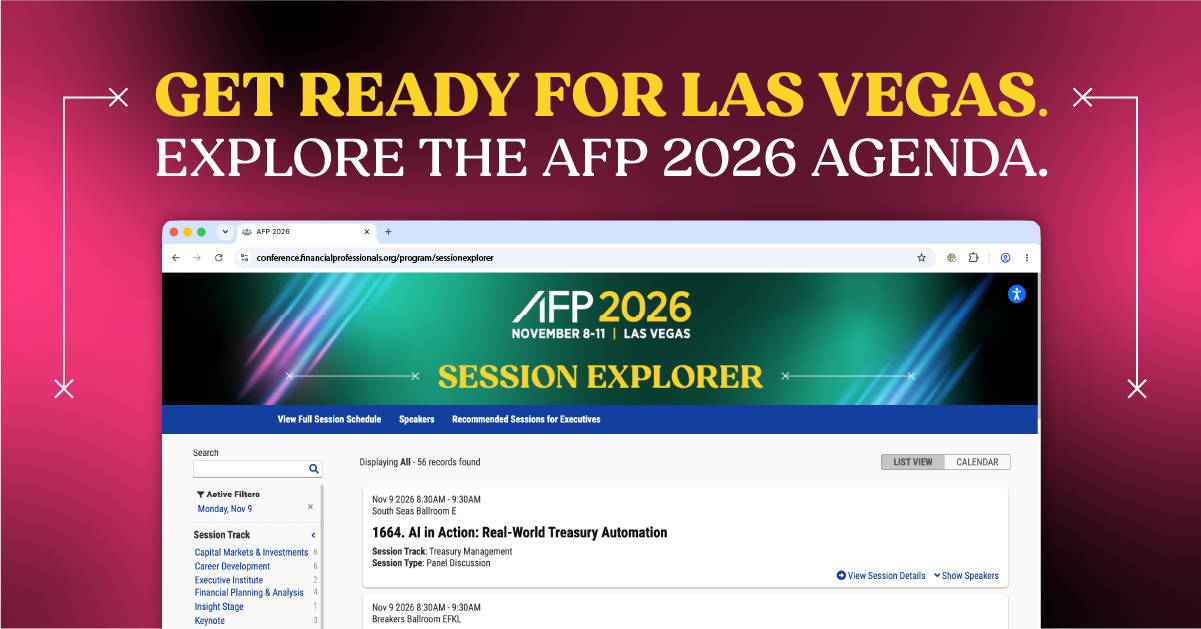
🔍 Browse 140+ sessions by day or track
💡 Discover the speakers sharing
real-world treasury and finance strategies
🤝 Find networking experiences designed
to help you connect with peers
📅 Build your plan before you arrive
Start Exploring
AFP Membership
The Hub for Treasury and Finance Professionals
As an AFP member, you'll gain access to exclusive training, certifications, research and networking to advance your career.
AFP Newsletters
Unbiased, practitioner-driven information for treasury and finance professionals
Subscribe to an AFP Newsletter to receive the latest news, events and trends in FP&A, Treasury or career planning.